










Our Ultimate Goal is to Become a Real Time Smart Utility
Mujib Lodhi, CIO, Washington Suburban Sanitary Commission’s (WSSC)
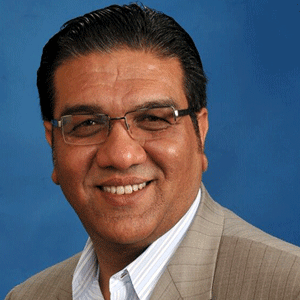
Mujib Lodhi, CIO, Washington Suburban Sanitary Commission’s (WSSC)
How technology is driving the current utilities landscape
It would be improper to group the water sector into the same category as the electric, oil and/or gas utilities even though their operational activities might carry significant overlap. This has a lot to do with the nature of the relationship with customers, the age, and accessibility of the infrastructure, the commodity like dynamics of electric, oil and gas versus water as well as other factors. Tolerance for loss of service for water is far less than other utilities. One can go but a day or two without water but could easily withstand weeks or even months without electric, oil or gas. It is water that enables settlement and habitation of an area more than anything else. So historically, the water sector has been largely focused on reliable and ubiquitous delivery of fresh drinking water as well as removal of all wastewater and has for the most part succeeded quite well in that almost too well.
Now the water infrastructure needs to be addressed as it has aged well beyond its intended life and is rated a D by the American Society of Civil Engineers. This aging infrastructure requires a significant investment that must also be managed efficiently since the scale of it will inevitably undergo significant scrutiny from stakeholders. With that in mind, the water sector is now in a mode of playing catch up with a customer base that has only interacted with their utility in a generally negative fashion.
The current challenge of upgrading the infrastructure represents an enormous cost proposition that would ultimately end up as a greater financial burden to the consumer unless creative innovation is applied. It is generally recognized that technology in cooperation with changing business and operational paradigms must drive the space going forward in Analytics, however, can be ineffective and potentially misleading unless the proper ground work has been laid in AMI Smart grids, advanced sensor and SCADA networks, asset management and myriad other data collection technologies from interconnected operational systems that provide a constant stream of high quality data.
Our ultimate goal is to become a real time smart utility. A monumental task when you consider we have 100s of thousands of assets, millions of customers, a responsibility to monitor and manage environmental impacts and a dynamic regulatory environment. Advanced and predictive analytics will enable us to achieve that goal.
It (Utilities Sector) is a dynamic, rapidly changing landscape where the past several decades focused on investments in the foundation elements of IT with very high service delivery. The next 10 to 15 years is all about analytics and providing insight to management to make informed decisions
The best Smart Grid implementations
The Smart grid in the water sector is still in its early stages. It is the right direction but we need to better recognize the smart grid as an opportunity to collect more data as a feed for analytics engines. A truly good smart grid implementation would likely assimilate IoT concepts with 2 way communications for real time remote command and control as well as interactions between grid technology from other services inside the home or business such as electric and gas or other relevant IoT devices.
Current technological trends
Analytics and Big Data have been addressed above. The cloud is the new reality though. Historically infrastructure was/is an in-house commodity. To be strategic and effective going forward those chokepoints need to evolve from a centralized tech heavy data center type concept to a more broad scale platform mindset which effectively incorporates the cloud. While it is important to do it right, it is more important to do the right things so cloud services and software must be strategically incorporated. Additionally, convergence should not be technology focused but also a convergence of the minds from tech to application to business. The cloud has a big role to play in all of this that will likely differ from organization to organization.
The ever-changing pace of technology influencing the Utilities landscape
Today’s CIO must be well versed in the business and their focus should be business oriented. As stated earlier – it is more important to do the right things than to simply do it right. To maintain this culture within IT, I always measure our success based on how IT contributed to the success of the organization, not on how well or how fast a technology was implemented. In this way, IT will inevitably become an integral part of the business strategy of the enterprise.
The changing role of a CIO
That change is still underway and remains very dynamic. Just 15 years ago, it was adequate for the CIO to deliver network services and equipment to the desktop all running on a basic fundamental IT platform. A growing number of CIO’s thru the last decade started transforming their operations from one of fundamental support to IT organizations capable of handling and/or managing critical business functions as well as driving strategically oriented, business focused, technological innovations that added or created new business value. This is where the CIO had truly engaged with the C-Suite and developed the respect of his fellow Chiefs and is still a growing movement for many CIOs that is not without its own challenges going forward Tech plays a big role but the business and business challenges drive the role tech can most efficiently play. To deploy technology first and then expect the business to adapt may very well drive the business into a corner where productivity improvements become unsustainable and may in fact start to decay over time. With technology advancing rapidly concepts like convergence are enabling us to do more with less while improving our ability to create new business value all the same. We are not just working smarter as a business, we are working smarter within IT as well.
Check Out : Top Utility Analytics Solution Companies
