



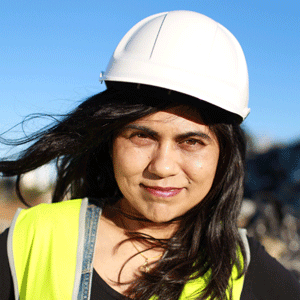







Hanna Uusitalo, Environmental Director, KONE
Building owners and developers are becoming more and more aware of the importance of sustainable building and construction. A little known fact is that 69 percent of anelevator’s carbon dioxide emissions are generated during the elevator’s use while only 21 percent originate from the elevator’s material production.
The need to provide safe, environmentally efficient and high performance products and services has been acknowledged in the elevator and escalator industry as a tactic to decrease costs and counter climate change and its negative effects. The question of how to help buildings save energy has been on the agenda for a long time for KONE, an elevator and escalator company. All of the company’s eco-efficient product innovations are based on new ways of using existing technology.
At the heart of KONE’s technological breakthroughs lie improvements made in five areas including efficient hoisting, energy regeneration, energy-efficient car lighting, energyefficient standby operation and destination control. By paying special attention to these features, the company has managed to cut the energy consumption of its volume products by over 70 percent as compared to 2008 levels.
Equipped with hoisting machinery, which limits energy consumption by reducing the amount of energy lost as heat, the elevators are made 50 to 70 percent more energy-efficient than those that use conventional technologies. A regenerative drive recovers potential energy from the ascending or descending car and can save up to 35 percent of the total energy consumed. Also, KONE’s elevators are equipped with LED lights that use up to 80 percent less energy than conventional solutions.
Enhanced standby options reduce energy consumption even further, making it close to nil when the elevator is not in use. Finally, destination control systems optimize traffic, reducing the number and size of elevators required.
Eco-efficient technology innovations also play a role when one thinks savings from the equipment lifetime perspective. Elevators and escalators have limited lifespan and reach the ends of their lives after about 25 or 30 years. Modernization is a good way to lengthen the useful life of a solution. It’s important to determine whether the elevator or escalator needs to be replaced entirely or if only a part or a sub-solution can be replaced.
"It is possible to achieve energy savings of up to 70 percent with the modernization of an elevator and up to 50 percent with the modernization of an escalator"
For example, it is possible to achieve energy savings of up to 70 percent with the modernization of an elevator and up to 50 percent with the modernization of an escalator. For building owners this translates into improved energy efficiency but also reduced operating costs and predictable life-cycle management.
At the End of the Equipment’s Lifespan
Some of the leading players in the people flow industry also take into consideration what happened at the end of the equipment’s lifespan. For example, KONE has committed to offer solutions that don’t just consume less energy but also use as many recyclable materials and components as possible. For example, one of KONE’s elevator models is composed mainly of metals, specifically steel and cast iron. In terms of material weight, about 97 percent of the entire productis recyclable. Add to this the fact that the equipment does not contain harmful chemicals like asbestos, paints containing lead or cadmium pigments, condensers containing PCBs or PCTs, or chemicals that deplete the ozone layer such as CFCs, or chlorinated solvents.
Bright Future Ahead for Green Building
At the moment, green and smart buildings are a major construction trend. The future of this development lies in the zero net energy buildings that are already coming onto the scene today, even producing more energy than they consume over the course of a year. They are designed to provide a healthy environment for the people that live in them.
Only sustainable materials such as certified wood are used throughout these buildings and in the solutions they use to function. Nearly zero waste is produced, meaning all waste fractions are recycled and waste management processes are planned for theconstruction siteand for the building itself during its life. This includes all waste, down to the packaging for solutions such as elevators and escalators. In short, thesebuildings will reach even higher benchmarks than those that green building certifications such as LEED, Green Mark, Green Star, and BREEAM currently strive for.
Five ways to make an elevator more eco-efficient
1. A green hoisting system saves 50 to 70 percent more energy than conventional technology. 2. Regenerative drives can achieve energy savings of up to 35 percent. 3. Eco-efficient LED lighting is 80 percent more efficient than halogen lights. 4. Standby solutions conserve energy when the elevator is not in use. 5. Destination control systems optimize traffic flows, reducing the elevator capacity required.
