












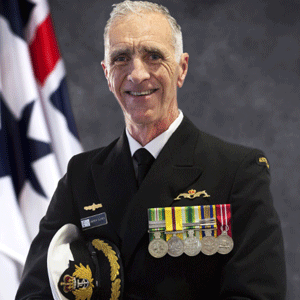
Andrew Clowes, Head of IT, JLL
JLL (NYSE: JLL) specializes in commercial real estate services and investment management. Incorporated in 1783, the US based firm comprises of 60,000 employees and 280 corporate offices in more than 80 countries.
When reading various journals, I often come across articles about what IT needs to be in order to fulfill its mission for the business. There are some who suggest that it needs to be a service – meeting the demands of the business in the most efficient manner. Other authors suggest that it needs to be a business enabler – closely aligned and allowing the business to succeed. More progressive pundits go further and suggest that IT should be driving the business forward with innovation and new products.
After more than 35 years in the Navy (fulltime and part time), I’ve been able to distill most of what I do in business (and in particular in the world of technology) into some fairly simple operating models. The military is often viewed as a rigid hierarchical structure where commands are issued from the top and those below simply carry out those orders. Whilst this might be the view in the Hollywood movies, nothing could be further from the truth in today’s modern military. Throughout all layers of a successful fighting force, commanders still need to set priorities, engage with the team and yes, give orders. However, in my experience and one which I have taken into business, the most important thing that people (whether in a uniform or a suit) need to know are the priorities. In the Navy, we call these the command priorities and they are distilled down into 3 – Float, Move and Fight.
Float
In a warship, the concept of floating is pretty obvious. It is your lifeblood. Don’t get that bit right and pretty much everything else is irrelevant. So when a warship goes into action and sustains damage, the command needs to quickly assess the damage, determine the risk and then allocate resources appropriately. Do I need to focus my attention on making sure we don’t sink or can we continue to move and continue to take the fight to the enemy? In the world of IT, floating is akin to making everything work. It’s ensuring that all the boring things like routers, switches, Wi-Fi, networks etc. all work and the organization isn’t at risk of sinking. When I first started in my current role, my command priority was around floating – we simply had to get the basic stuff of IT right. Everyone knew it and that was where our attention was focused. It just doesn’t make sense to try and have a discussion with the business leadership about Artificial intelligence, Big Data or Analytics, when you are at risk of sinking. "Through out all layers of a successful fighting force, commanders still need to set priorities, engage with the team and yes, give orders."
MOVE
Warships at sea need to move. Without that fundamental ability, you are simply a target. You need to be able to move in order to take the battle to the enemy (or change direction) – but more importantly without being able to move, you can’t open your weapon arcs, take evasive action or launch your aircraft. In business, not moving is akin to stagnation and ultimately, if you don’t change, you die. In IT, moving is about getting into a rhythm that supports the business – refresh cycles, introducing new technologies and ensuring that you have the ability to grow as the business grows. One might say that is the boring and mundane part of IT – but it is what keeps the organization moving forward.
Fight Once again, from a military perspective, this bit is pretty obvious. Fighting is about being aggressive, executing a plan and delivering a result. It isn’t about following – it’s about assessing your threats and developing the tactics and strategy to neutralize the threats and ultimately win. In IT, fighting is about bringing in new technologies, experimenting and taking on new challenges that only technology can solve. It’s about Big Data, Analytics, Robotics, Neural Networks and all those technologies that are radically changing our world. Those of us in IT would say it’s the fun part. However, like a warship, you just can’t spend your whole time fighting – it just isn’t sustainable. As a CIO though, this is where you add the real value to the business. That said, when necessary, you still need to be able to get your hands dirty when you need to just float and move – that’s leadership. So what is your Command Priority?

