











5G: The Roadmap to Launch in Asia
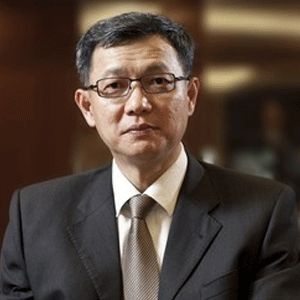
Quah Mei Lee, Industry Principal – ICT Practice APAC, Frost & Sullivan

Quah Mei Lee, Industry Principal – ICT Practice APAC, Frost & Sullivan
By 2022, there will be 280 million 5G subscriptions in Asia Pacific, with 5G service revenue reaching US $ 4.5 billion.
Compared to previous generations of networks, 5G’s significance lies in its capability to offer real time end-to-end service offerings. Alongside the emergence of technologies such as IoT, drones, smart devices, and with increased mobile phone uptake, 5G has been seen as a key enabler of all these by providing the infrastructure to carry large amounts of data, creating a smarter and more connected world and also driving the digital economy.
For Asia, a region that has one of the highest mobile penetration rates in the world, the potential for 5G to transform the region and advance the development of smart cities is an exciting possibility set to become a reality soon.
Upping the Ante
Asia presents a unique setting for 5G – a populous region with fast-growing, increasingly-digital economies that have the desire for speed and connectivity. 5G will fundamentally change industries including transport, healthcare, communications and supply chains.
Faster internet speeds at more cost effective pricing per gigabyte could enable new business models and contribute towards economic growth and digital economy transformation. For businesses, this presents new monetization opportunities – at 1,000 times faster than 4G, 5G could deliver smooth, HD content in seconds and redefine audience engagement with real-time targeting.
For consumers, 5G technology could mean a real perceivable difference over 4G technology. By providing the processing capability and ultra-low latency required for the consumer to fully experience a service offering, 5G could change the face of AR/VR, as well as gaming in the most fundamental way, particularly in Southeast Asia that is home to a booming e-sports and gaming industry.
The dream of an ultra-connected, efficient society is already in the making, and if a smarter and more connected world is the future, then 5G could be the highway to get us there
A fully connected world could also be made possible where a massive number of devices can be connected simultaneously, enabled by 5G. The capability of 5G networks to manage large quantities of data at high speeds will realize full potential of IoT, in smart sensors, wearables, and other devices.
Getting on board
Countries like China, South Korea and Japan are in the process of rolling out 5G across their cities, with other countries across Asia expressing keen interest to do so. However, successful 5G implementation within each country is an open question.
While countries such as China are well placed to develop and implement 5G, for developing countries this could prove to be a challenge, where demand for 5G services is finite or limited. Though possible for developing nations to leap frog to 5G, a key question to consider is the need for 5G within and beyond government driven initiatives, particularly given that costs remain a limiting factor and that mobile network operators are assessing the capabilities of 4G before deciding to invest in 5G to supplement it.
Getting everyone on board 5G initiatives could prove to be a hurdle too. Although 5G is fast gaining momentum, businesses are yet to see the immediate need for 5G until its full benefits and opportunities for monetization become apparent. This could delay integration of 5G into solutions and service offerings.
Similarly, consumers still hold a ‘wait-and-see’ approach until 5G-enabled devices and solutions are able to transform their lives in an impactful way – such as the use of cost effective wearables, e.g. an augmented reality helmet used by a blind person for safe navigation in real time or sensor triggered braces that aid mobility in disabled people.
Stepping Stones
Despite the hurdles, early developments in 5G are already revealing new, exciting opportunities that are proving 5G’s potential in various use scenarios and allow us to go truly ‘wireless’.
Mobile network operators play a crucial role in the success in its implementation. However it is necessary for them to understand the need and therefore demand for 5G and focus on industries that can bring them the best returns.
In line with this, support from governments and working with other stakeholders within the ecosystem will be crucial to pushing 5G in their markets.
In the future, the possibility of a mobile network that is seamless, converged, and offering end-to-end services at the right price points could be a reality. Along with this, the leading edge use of artificial intelligence to drive safe and secure real time service offerings could also become a real possibility.
The dream of an ultra-connected, efficient society is already in the making, and if a smarter and more connected world is the future, then 5G could be the highway to get us there.

