

A featured contribution from Leadership Perspectives: a curated forum reserved for leaders nominated by our subscribers and vetted by the Construction Tech Review Advisory Board.

Group Capital Expenditure and E & O at Orora
A Sustainable & Evolutionary Digital Procurement Practice
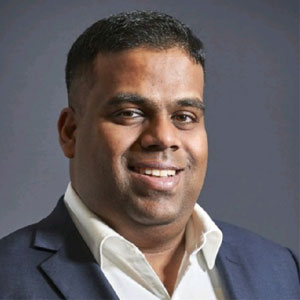
Shehan Thambimuttu
Humans have a “sixth sense”. Our genetics have a mysterious capability to make sense
of our environment and millions of other facts when making decisions.
For example, scientists have been using an online portal for the general public to
participate in trying to find protein folding patterns (for example to find COVID-19
antivirals). Computers have to carry out millions of trial-error computations, to find
potential solutions for how a protein chain may fold. Humans on the other hand may
deduce the folding pattern in a few simple tries backed by our amazing human
intelligence.
Given this, humans are an invaluable and irreplaceable resource in a decision making
process in any organization.
But we have flaws.
We are not as fast as computers in computing millions of transactions per second. We
become complacent and overlook risks. It may be too daunting (or impossible) to review
millions of archived records to find patterns or statistics that would unearth new insight.
Humans and computers work best in an augmented environment. Where we use our
sixth sense while being kept in check using computing and artificial intelligence.
Procurement process is one of the most complex functions within an organisation. It
serves as the backbone in a manufacturing organisation and It is paramount that the
forming units of the procurement workflow interconnect well to provide a transparent
and clear view to the entire organisation.
Biology solves the problem of inter-connection extremely well more than anything else
in the universe. Each unit in a biological context has a unique function to perform. The
individual unit uses a multitude of sensors as input to perform its duties and evolve into
the best form possible to perform its function.
Looking at this analogy, we can observe how we fail to apply these natural principles in
our day to day operational units.
We don’t apply the same rigour that nature showcases when setting up our
business units or functions or inter unit communications and information flows.
We don’t use the invaluable archives of organisational, environmental and
sensory data when making decisions like nature does.
We don’t involve the same level of sophistication for risk detection, aversion and
suppression with the same preparedness as our biology does.
We don’t evolve like nature has been for millions of years to optimise our
functional units, thereby becoming more efficient and productive.
But technological innovations have given us a plethora of tools to mimic nature in
becoming efficient and analytical in decision making.
In order to digitally transform our procurement unit and its workflows to work in synergy,
like a biological unit, we should adopt and embed some key foundational technologies
in our organisation.
For example organizational data is the key to unlocking new potentials and
understanding failures of the past. We generate a large volume of data that is
impossible for humans to digest and correlate to elicit findings in a reasonable
timeframe. In this scenario a Big Data Framework can be used to catalogue each and
every piece of information. The ecosystem of tools should also support exploration and
inquiry of this data readily to identify patterns and trends. Machine Learning (ML) and
Artificial Intelligence (AI) should be embedded beside this to provide augmenting
intelligence throughout the decision-making process.
This would help to predict the
most likely scenarios for cost/price fluctuations, demand, supplier/country risks, and
enable proactive decision making.
Even though risk assessment and management practices have evolved over the
decades, we are more on the reactive end of the spectrum. Risk monitoring and reaction should be defined with Agile Business Process Management (BPM) tools. BPM allows
for agile workflow definition and transparency. ML models and AI should be developed
for risk monitoring and prediction. This would allow real-time tracking of online/physical
activities and also provide proactive monitoring of supplier behaviour, performance,
trend and predictions on supplier (or supply chain) risks.
Communication and Compliance Verification (validation) is another unit to transform. A
large enterprise generates many channels of communication. It makes it hard if not
impossible to visualise these information flows. Information security and confidentiality
are added concerns that have to be dealt with in this maze.
By incorporating digital tools in communication and compliance validation channels, it
is possible to use humans only in the most meaningful paths of communication and
validation. Digital Assistant Bots and Robotic Process Automation (RPA) are key digital
transformation techniques in these areas. They improve the quality, confidentiality and
safety of communication.
RPA is extremely powerful, as it allows for automating processes and workflows
connecting even legacy systems. Digital robots can release humans from mundane
processes, but also speed up communication channels dramatically. RPA has been
embraced by the industry as a serious ROI capable practice both in cost and quality.
Purchase order creation, invoice processing, work order management are few of the
areas within procurement that can be directly benefited from RPA technologies.
Storage of communication, decisions and contractual information in a non-repudiation
form would eliminate lots of misunderstandings. Enterprise Blockchain is here just to
provide that non-repudiation capability. This cryptologic data structure uses a trusted
peer-to-peer network to create digital transaction ledgers which can verify and validate
transactions in the P2P process (or any other supply chain process) and then be used to
trigger automated payment (smart contracts).
In a natural process, all energy is released back to nature for a new beginning in the
ultimate Recycling process. This makes nature sustainable and evolutionary.
Fundamental change in an organizational process and attitude is required to make
carbon cost calculated and attributed as a metric to every piece of procurement
process.
This improvement in measurability could be coupled with AI to develop prediction and
prevention models. New supplier routing, packaging changes, sourcing changes could
be unearthed through these tools to improve a sustainable supply chain.
Consumers are becoming extremely observant and sensitive to environmental impact
and sustainability of services and products. Organizations which do not treat
sustainability as a core attribute in its processes will become an undesirable product or
service in the market. This is a global trend which businesses need to aggressively
adapt and transform to achieve.
AI could automatically profile and conduct intelligence gathering on supplier
sustainability. These scorecards could provide information to potentially collaborate
with the supplier to improve their sustainability profile, thereby making a larger impact.
These playbooks should in turn be shared with the wider global community to develop
socially and environmentally sustainable practices.
Real Time Analytics should be ever present to provide risk, tactical, strategic overview
into business flows. The pulse of the operating units should be ever visible and
transparent to key decision makers. Tooling should allow for deep dive and traceability.
IOT could be part of the sensor network to feed into the real time organisational pulse.
Coupled with GIS systems, the spatial analytics provides a geographical perspective to
intelligence reporting.
In summary, procurement workflow can be modelled as a biological framework. Units of
it like communication, risk management, information centre, contract and compliance
data, real time data are vital pieces of the chain.
Digital transformation is essential to augment the human intelligence in these units to perform like nature would. Lack of meaningful digital transformation in the essential
units would result in un-natural operations causing business to eventually fall into
chaos.
An elixir tool, framework or solutions offering does not solve the problem of
naturalisation. Because it does not take into consideration the biology of the
organisation.
Digital transformation is improving the biology of the organisation by augmenting
unparalleled human intelligence with key technologies in all business units. It should
feel natural within the business, provide agility and help unlock a sustainable and
environmentally responsible future.
