











Addressing the Elephant in the Room - Towards Long Term Sustainability of Smart Cities
Richard Raj Sebastian, Head and Assistant General Manager - Innovation And Technology, Gamuda Land

Richard Raj Sebastian, Head and Assistant General Manager - Innovation And Technology, Gamuda Land
-(1).jpg) What’s Being Done
The good news is smart cities is now being actively discussed at all levels; from national to municipal levels to even being actively promoted by large real-estate developers. Besides awareness, stakeholders across the region are piloting and pushing ahead various projects to address challenges faced in governance, mobility, safety, energy, and healthcare, amongst others with the goal to enhance the overall quality of life of its population further.
The majority are also beginning to acknowledge several other factors which have impeded many early smart city initiatives; this includes smart cities being about addressing real-life business and use cases rather than a technology showcase, in addition to the need for open-loop rather than closed-loop systems to address scalability issues, and the ability to cater to all groups of stakeholders needs rather than selective users. There is even beginning to see talks of ensuring the design of green-field developments to factor in all sustainability aspects such as materials used and design process from the onset to ensure it enables a smart and sustainable development.
What’s Being Done
The good news is smart cities is now being actively discussed at all levels; from national to municipal levels to even being actively promoted by large real-estate developers. Besides awareness, stakeholders across the region are piloting and pushing ahead various projects to address challenges faced in governance, mobility, safety, energy, and healthcare, amongst others with the goal to enhance the overall quality of life of its population further.
The majority are also beginning to acknowledge several other factors which have impeded many early smart city initiatives; this includes smart cities being about addressing real-life business and use cases rather than a technology showcase, in addition to the need for open-loop rather than closed-loop systems to address scalability issues, and the ability to cater to all groups of stakeholders needs rather than selective users. There is even beginning to see talks of ensuring the design of green-field developments to factor in all sustainability aspects such as materials used and design process from the onset to ensure it enables a smart and sustainable development. What many parties do not talk about enough is the introduction of smart cities also requires re-visiting the way smart cities are funded
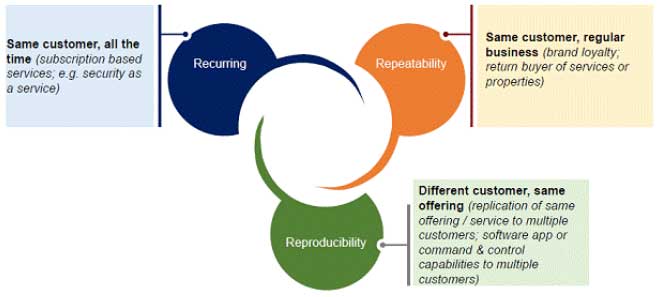
 As a leading real estate developer in the region, Gamuda Land’s is looking at instituting on a city-as-a-service model when deploying its smart city plans for its projects. It is also exploring the ‘urbanization’ of various services required by its residents to manage the cost of running these solutions better. The medium to long-term strategy will focus on the 3R’s which are Recurring, Repeatability and Reproducibility as outlined in the diagram above. It will serve as the guiding principles for Gamuda Land, which ultimately looks at monetization of services that will make its overall smart township and city a sustainable vision.
A similar approach can be made even in governmental level smart city projects to make it more viable for the long term. Aided with a digital suite of offerings and where the Smartphone has become ubiquitous, stakeholders need to be more creative when looking at funding options and consider embracing a services-based model; whether pay-per-use or long-term subscription-based on individual needs will ensure continuous applicability of the smart city solutions.
As a leading real estate developer in the region, Gamuda Land’s is looking at instituting on a city-as-a-service model when deploying its smart city plans for its projects. It is also exploring the ‘urbanization’ of various services required by its residents to manage the cost of running these solutions better. The medium to long-term strategy will focus on the 3R’s which are Recurring, Repeatability and Reproducibility as outlined in the diagram above. It will serve as the guiding principles for Gamuda Land, which ultimately looks at monetization of services that will make its overall smart township and city a sustainable vision.
A similar approach can be made even in governmental level smart city projects to make it more viable for the long term. Aided with a digital suite of offerings and where the Smartphone has become ubiquitous, stakeholders need to be more creative when looking at funding options and consider embracing a services-based model; whether pay-per-use or long-term subscription-based on individual needs will ensure continuous applicability of the smart city solutions. 
