

A featured contribution from Leadership Perspectives: a curated forum reserved for leaders nominated by our subscribers and vetted by the Construction Tech Review Advisory Board.

Swiss Re
Digital Ecosystems are Extending the Boundaries of Value Creation in Insurance

Yannick Even
Unlocking the Value of Data – Claims Analytics Case Study
This evolution is starting to impact the entire insurance value chain. The growing proliferation of new data collected from customers and the insured via sensors and smart devices, allows for more granular understanding of individual risks, customer's behavioral changes and people's protection needs, thus enabling us to better prevent and manage risks.
More recently, we helped a client improve the accuracy of their existing cost-prediction model for medical claims to 95 percent, by combing predictive modeling and machine learning with our accumulated wealth of knowledge as risk managers. This collaboration proved valuable for our client, as they were at the time, experiencing a significant rise of more than 100 percent in medical claims paid over the last five years, which impacted their claims forecast and overall business planning. This is one of the many examples of how our data science and smart analytics capabilities, alongside our risk understanding has provided fresh perspectives to client actuaries in analysing their data, and ultimately improving their risk management.
Moving across the value chain, insurers are also starting to create more efficiency in underwriting and claims management processes by using mobile applications to collect data and leveraging machine learning and pattern recognition to analyze handwritten and unstructured documents.
Enhancing the Insurance Customer Experience
Distribution channels are also evolving. Consumer surveys indicate that people continue to value personal engagement and expert advice of agents and brokers, especially when it comes to complex insurance policies for commercial, financial and life and health risks. And in many countries in Asia, traditional intermediaries still represent the dominant channel through which insurance policies are sold. In these areas, technology is being applied to improve the efficiency and effectiveness of agents and brokers.
The Rise of Digital Ecosystems
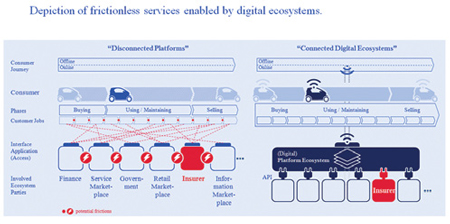
An extension of the digital revolution has been the rise of digital ecosystems across the world. These are networks of businesses and consumers (online and offline) that support each other with their respective services or product offerings to improve the economic value delivered. Connected ecosystems create a simpler experience for consumers, through a single window interaction that eliminates points of friction between the different participants of the ecosystem. Solutions that are normally independent and distinct are synchronized to offer customers a holistic and hassle-free experience. For example, an ecosystem can offer a one-stop-shop solution for mobility, rather than having a consumer make separate purchases for the different needs throughout their travel (such as a car, taxi rides, payment solutions, service plans and insurance).
It is fascinating to see the growth in smartphone usage across the world.
 A large portion of the unbanked and uninsured population in Asia is already on mobile devices. The vast majority of the next billion middle class consumers will emerge from Asia; this population is a key segment for future insurance growth. Companies that can quickly transform mobile/digital ecosystem data into risk insights and tailor products and services could be winners. As a flavour of what to expect, it is interesting to see how financial services firms have leveraged scores built by tech giants in China, to onboard new customers and enhance traditional models.
 Insurers with more complete knowledge of end customers can play a more active role within an ecosystem
The Impact of Digital Eco-Systems on the Insurance Value Chain
Insurance is a service offering that fits very naturally into different ecosystems, including mobility, healthcare, housing, and B2C and B2B marketplaces amongst others. Re/insurers can feature as the risk mitigation service for these ecosystems or constitute their own sub-ecosystems that cater to specific individuals and institutions. Emerging digital risks also create new protection gaps and new business opportunities around counterparty risks, business interruption, and system failure.
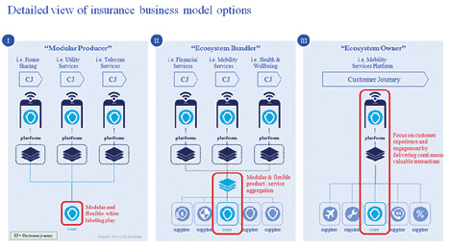
Insurers can adapt to these developments by developing three different set-ups. (1) Modular producer: providing plug-and-play products or services that can adapt to a variety of platforms or ecosystems. (2) Ecosystem bundler: Creating relationships with other providers that offer complementary or sometimes competing services, and (3) Ecosystem owner: More aggressive insurers could act as active ecosystem owners or orchestrators.
Insurers who possess only partial knowledge of the end consumer and typically sell a standard set of offerings through another company, may have to transform into "modular producers". This means being able to offer plug-and-play white label solutions, constantly innovate their products, and rapidly adapt to newer ecosystems as they emerge.
Insurers with more complete knowledge of end customers can play a more active role within an ecosystem. Such insurers typically “own” the customer relationship and currently operate as omni-channel businesses with an integrated value chain which allows them to offer a multi-product, multi-channel customer experience. These insurers could design their business to play the role of an "Ecosystem Bundler" with modular and flexible product/ service aggregation. Here they create relationships with other providers that offer complementary (sometimes competing) services. A bundler can plug an aggregate set of all products and services around insurance into an ecosystem.
More aggressive insurers could aspire to be "Ecosystem Owners". In other words, be the sponsor that provides a branded platform and leverages its customer knowledge and data to match customer needs with third-party providers. Their focus is on customer experience and engagement by delivering continuous and valuable interactions. They act as active ecosystem orchestrators, monetizing new technologies and services, and accessing new revenue pools, through proactive interaction based on continuous flow of data (personal, behavioral, etc.)
Irrespective of the choice of business design, this environment requires distinctive capabilities and relies heavily on access to data and the capability to model risks. True leverage will only be created in combination with other assets, such as key partnerships with suppliers and other firms that allow re/insurers access to ecosystems. Utilised more fully and intelligently, digital ecosystems present an opportunity for the insurance industry to reinforce its relevance to its clients whose tastes and protection needs are changing.
