

A featured contribution from Leadership Perspectives: a curated forum reserved for leaders nominated by our subscribers and vetted by the Construction Tech Review Advisory Board.

Strateq Group of Companies
Drone Threats: Detection Before Counter Measure
Will Poh
One of London’s busiest airports Gatwick was the scene of a major airport disruption in December 2018. Air travel was halted when drones were sighted on three consecutive days resulting in more than a thousand flights being cancelled or diverted while affecting more than 100,000 passengers. The financial repercussions were devastating for airlines, airports and passengers. This new vulnerability is no longer an anomaly as authorities scurry to install and deploy military grade equipment to counter future drone intrusions.
A single autonomous drone is all it takes to shut down an airbase. Airports both commercial and military need to invest in reliable drone detection and countermeasure capabilities.
While drone threats are now a recognized danger worldwide, aviation authorities and governments around the world are still insufficiently prepared to respond to drone intrusions.
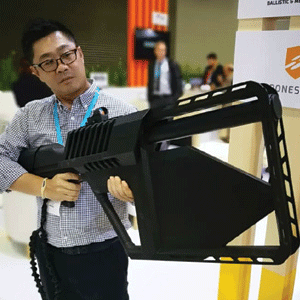
While navigating drone threats, it is crucial to separate two fundamental elements of the equation; detection before countermeasure. The underlying process is you cannot defeat what you cannot see. Companies like Strateq and its technology partners focused heavily on developing drone detection solutions and classification technology while implementing suitable countermeasure devices. Such technology leverages a range of sensors including radar, acoustic, radio frequency, and cameras to identify drone intrusions. Countermeasure solutions like radio frequency jammers can be a very expensive proposition and they are only effective if location or early detection of drones are accurate and immediate.
Most drone users realized there are no mechanism of enforcement fully in place to protect against their potential misuse
Regulations, though necessary, won’t accomplish deterrence of rogue drones alone. Countless near-misses with aircraft, power outages caused by drones
crashing into electrical lines, and the dropping of contraband into prisons are a few ways that exemplify laws will always be broken. A concise drone identification solution coupled with effective UAS Traffic Management will prevent most rogue pilots while educating new adopters into responsible drone pilots. Installation of effective detection devices will be the crucial first step to manage these drones. Forensic data captured from detection phase will be the basis for prosecution and regulation.
The future of drone threats will look very different if we have robust policies in place and a united industry committed to mitigating them. Unless we act proactively and defend all critical infrastructures with reliable detection solutions, no amount of countermeasures are able to prevent a catastrophe from happening. But while it might take some time before new regulations are in place in most airports, one thing is quite clear: drones are now a reality which, when it comes to airport security, can be addressed and prevented with the right mitigation solutions.
