

A featured contribution from Leadership Perspectives: a curated forum reserved for leaders nominated by our subscribers and vetted by the Construction Tech Review Advisory Board.

RGE
Industrial IOT for Paper Industry 4.0

Abhishek S
Cost optimization remains as the critical factors to drive for better results. The use of Industrial Internet of Things (IIOT) allows us to use analytics and artificial intelligence with the data collected, sending commands directly to the production process, complementing the legacy use of distributed control systems (DCS) that tends to operate in segregation today. The process of paper making is complicated and constantly fluctuates. A lot of time and capital are invested to streamline the production and understanding of what’s needed to elevate the performance. Kappa number is a critical component to measure residual lignin of a pulp. The process of producing consistent yields can be quite challenging and inconsistency in kappa number may result in higher chemical cost or even loss in production. Therefore, forecasting for better accuracy is vital to make out actions relevant to different production aspects. For this reason, a data-driven prediction on the model combined with artificial intelligence churns huge volume of data and learns continuously to offer the best-optimized value on achieving the targeted kappa level. By doing this, the entire physical process of delignification of wood chip into pulp slurry is transformed into a statistical model. Data analytics programs helps to identify bottlenecks in the process and machine learning models are then integrated to learn from the process, recognizing the patterns and the consumption of chemicals to predict the kappa number for each individual delignification process. Variables that affect the result of kappa number to a large extent can be known and controlled, thus, achieving consistent kappa number and pulp yield. Machine learning models are also applied as it can be dynamic and able to address different scenarios with large changes and fluctuations.
Paper industry is an asset and labor intensive operation, smart sensors are used to detect and trigger early warnings signs of machinery issues and even more importantly, predicting the likeliness of equipment break down or malfunction even before it happens, reducing the unplanned downtime and achieving better overall equipment effectiveness. The current practice for anomaly detection often relies on the process control chart and manually setting the upper and lower bounding limits for each parameter of interest. However real-world hardware failures are usually caused by the distributed deterioration of components which are at different stages of their respective lifespan, and sometimes a critical failure may only be detected further down the production line. Hence, the combined used of sensors and machine learning algorithms that classify the vibration signal patterns are able to process the large scale of data collected provide predictions of impending failures ahead of time.
The vibration signals from bearings, for instance, are monitored for their spectrum and enveloping energy levels passes through a clustering algorithm to identify abnormal operation patterns. Based on these patterns, we can then perform prediction of the anomalies by using historical vibration data and also, records of loss reports that contain machine equipment failures. When a known operation indicates a certain pattern, it would warrant for an alert or alarm, directs the right response alternatives to the available knowledge worker to prioritize and execute the corrective action. 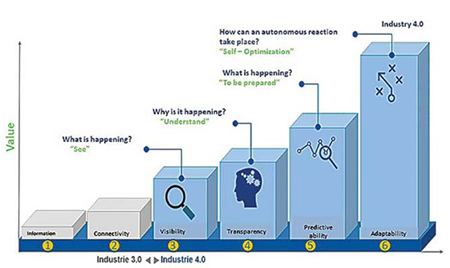
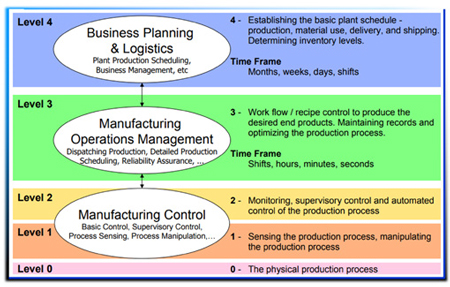
However, the interoperability of various industrial systems remains a major obstacle that needs to be addressed by manufacturers. The heterogeneous environment of plant automation systems comprising of scheduling, product recipes, equipment availability, and other elements are necessary for achieving a realistic production plan. International Society of Automation (ISA) is an organization that sets standards in the field of automation developed ANSI/ISA-95,an industry-standard providing a guideline on plant-wide system and implementation model, facilitating ease of communication across the enterprise, lowering the total cost of ownership and enabling error-free system integration.ISA-95 standard uses a top-down approach flow dispatching information from a pre-computed schedule to the plant floor. Traditionally, production targets are defined at enterprise resource planning (ERP) and the feasibility of a schedule is assessed by the manufacturing execution system (MES) if the targets can be produced. The values of the production batches are monitored by PI system, a real-time data acquisition repository integrated with sensor readings and supervisory control and data acquisition (SCADA) system providing visibility of equipment status. Business then uses this information and to look for correlations, perform comparison, and optimization of different lots in production. This information are also used to determine if maintenance is required on the equipment. Therefore, it’s critical to efficiently transfer these disparate data into a more meaningful and actionable manner that are shared between the production environment and business applications for real time use. With the application of advanced algorithms, business are able to control quality and maximize production autonomously, by applying a simplified predictable process that displays the production plan, maintaining its flexibility on accommodating for changes and creates an environment to communicates effectively.
The application of industry 4.0 is vital to any business, to remain competitive and ensure future growth. Industry 4.0 maturity model is an integrated approach to ensure the success of transformation initiatives. A full comprehensive assessment of the company’s current state, visibility over its manufacturing process are needed to gain comparable and tangible insights. To achieve this, the business has introduced the use of operational excellence platform to achieve a competitive superiority between its mills. This is to drive efficiency, reduction in operational cost and being able to run the mill operation in a predictable manner to meet customer demands. These initiatives are then aligned with Kaizen initiatives for continuous improvement across the entire organization. By having transparency of the existing process and methods, competitive advantage is maintained throughout the manner of standardization and optimization of the process formulas across the mills .Real time data collected from multiple systems are visualized in the form of dashboards with event based notifications and escalations workflows provide instantaneous support by roles. Through the use of intelligent analytics and models, historical data are used to baseline, evaluated and predict a future state. Performance data are then benchmarked to help alleviate weaknesses and identify improvement, in accordance with business scorecards and strategies. Market demand and productivity driven by asset conditions information can be integrated into supply chain planning systems, to help and notify production line in the event of a bottleneck, ensuring no loss in production yield and quality. This is where the genuine emphasis on 'disruptive' solutions are developed, bringing operation excellence to every layer of the business.
However, the interoperability of various industrial systems remains a major obstacle that needs to be addressed by manufacturers. The heterogeneous environment of plant automation systems comprising of scheduling, product recipes, equipment availability, and other elements are necessary for achieving a realistic production plan. International Society of Automation (ISA) is an organization that sets standards in the field of automation developed ANSI/ISA-95,an industry-standard providing a guideline on plant-wide system and implementation model, facilitating ease of communication across the enterprise, lowering the total cost of ownership and enabling error-free system integration.ISA-95 standard uses a top-down approach flow dispatching information from a pre-computed schedule to the plant floor. Traditionally, production targets are defined at enterprise resource planning (ERP) and the feasibility of a schedule is assessed by the manufacturing execution system (MES) if the targets can be produced. The values of the production batches are monitored by PI system, a real-time data acquisition repository integrated with sensor readings and supervisory control and data acquisition (SCADA) system providing visibility of equipment status. Business then uses this information and to look for correlations, perform comparison, and optimization of different lots in production. This information are also used to determine if maintenance is required on the equipment. Therefore, it’s critical to efficiently transfer these disparate data into a more meaningful and actionable manner that are shared between the production environment and business applications for real time use. With the application of advanced algorithms, business are able to control quality and maximize production autonomously, by applying a simplified predictable process that displays the production plan, maintaining its flexibility on accommodating for changes and creates an environment to communicates effectively.
The application of industry 4.0 is vital to any business, to remain competitive and ensure future growth. Industry 4.0 maturity model is an integrated approach to ensure the success of transformation initiatives. A full comprehensive assessment of the company’s current state, visibility over its manufacturing process are needed to gain comparable and tangible insights. To achieve this, the business has introduced the use of operational excellence platform to achieve a competitive superiority between its mills. This is to drive efficiency, reduction in operational cost and being able to run the mill operation in a predictable manner to meet customer demands. These initiatives are then aligned with Kaizen initiatives for continuous improvement across the entire organization. By having transparency of the existing process and methods, competitive advantage is maintained throughout the manner of standardization and optimization of the process formulas across the mills .Real time data collected from multiple systems are visualized in the form of dashboards with event based notifications and escalations workflows provide instantaneous support by roles. Through the use of intelligent analytics and models, historical data are used to baseline, evaluated and predict a future state. Performance data are then benchmarked to help alleviate weaknesses and identify improvement, in accordance with business scorecards and strategies. Market demand and productivity driven by asset conditions information can be integrated into supply chain planning systems, to help and notify production line in the event of a bottleneck, ensuring no loss in production yield and quality. This is where the genuine emphasis on 'disruptive' solutions are developed, bringing operation excellence to every layer of the business.
To push ahead with Industry4.0, a phased step by step approach in achieving excellence maturity Evaluate your digital roadmap with your current state and subsequently break it down to areas of, priorities and focus on the measures that will develop and shape your digital journey, ultimately delivering value for your business.
The articles from these contributors are based on their personal expertise and viewpoints, and do not necessarily reflect the opinions of their employers or affiliated organizations.
