

A featured contribution from Leadership Perspectives: a curated forum reserved for leaders nominated by our subscribers and vetted by the Construction Tech Review Advisory Board.

Scania Group
New Technologies and Methods as Means to Achieve Safer Transports

Alexander Mastrovito
Over 90 percent of these accidents are attributable to the human factor. The human factor in this case could be that the driver losing attention, making the wrong decision, fatigue and many more. In non-human caused accidents it could be due to environmental or vehicle factors like malfunctioning breaks, road-side construction, landslides and more.
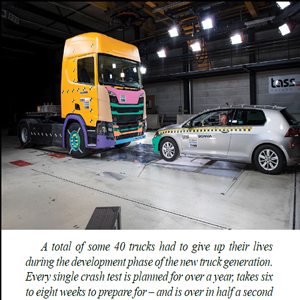
This kind of situation naturally comes at a huge cost for society and private enterprise, not to mention the obvious personal tragedies that each single one of these accidents represents. Safety is therefore a crucial bullet on the list of negative externalities that we as vehicle manufacturers need to deal with.
We do so through the development of new technologies and working methods. Some mandated by regulations, and others developed either as good internal ideas or spurred on by the requirements of our customers. But whichever its source may be, the goal is always to be able to transfer as much safety performance as possible to the operators of our vehicles.
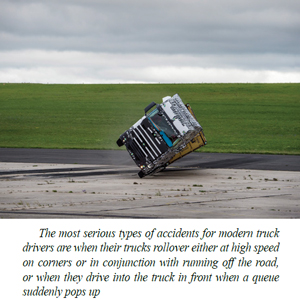
Today we see the most important developments for safer transports in the areas of Driver Training, Advanced Driver Assistance Systems, Driver Monitoring, Autonomy and the always present drive to make the basic functions of a vehicle as reliable as possible.
One of the oft-touted promises of autonomous vehicles is that they have the potential to eliminate the 90 percent human-error-derived part of those 1.3 million aforementioned traffic deaths
Driver training and coaching has been at the forefront of our safety agenda for a long time, as it at the same time as making driving safer, has led to other more quantifiable benefits like a lowered fuel bill. Training and coaching have since a few years back entered a new era of importance with the emergence of the connected vehicle. Connectivity has enabled real-time monitoring of driver behaviour and thus the possibility to have Driver Coaches that can intervene and remind drivers of correct driving behaviour. The knowledge that you have someone supporting your driving performance is in itself a strong incentive for improved behaviour.
Another technology we now see emerging to improve driver behaviour is using video sensors and biometrics (similar to a smart watch sensing your heart rate, or other sensors measuring sweat, breath) to alert drivers when the system senses that the driver is distracted or drowsy. This has seen its most expansive adoption in China where all long-distance buses have had the requirement to install Driver Monitoring systems – driven by a string of high-profile crashes with mass casualties. Requirements are expected to be extended to trucks as well, and indications are that transporter all around Asia will look to driver monitoring tech to reduce accidents even when not mandated by local policy. In Europe, privacy concerns will remain crucial for adoption of monitoring technology, but biometric solutions can safeguard driver’s privacy, as well as video capture solutions that use imaging to alert the driver without sending the video feed to a central location or storing it long-term, except in case of accidents.
An even higher tech area is the adoption of external sensor-arrays made up of cameras, radars and sometimes LiDARs (Laser radars) to allow for the vehicle to take certain safety related decisions on its own, otherwise known as Advanced Driver Assistance Systems (ADAS). Most notable are the automatic emergency brake (AEB), lane departure warning (LDW) and blind spot warning (BSW) functionalities. But other functions are on the horizon, and the fundamental architecture of ADAS is moving vehicles closer to the autonomous future that so many companies are pledging.
One of the oft-touted promises of autonomous vehicles is that they have the potential to eliminate the 90 percent human-error-derived part of those 1.3 million aforementioned traffic deaths. While an admirable ambition and theoretically plausible, that outcome could be far away. Fully autonomous vehicles are not yet able to handle normal operations in complex environments frequented by a mix of road-users. Autonomy will have great efficiency gains in limited use-cases in the short-term, but the long-term future will leave us waiting.
While all these exciting high-tech developments are gaining ground vehicle manufacturers are also fine-tuning the basics. Airbags are still far from standard all over the world, neither are vehicles always properly maintained. Simple things like putting on your seatbelt is also not a given in many places. The quest for smarter and more intuitive solutions to old inventions is ongoing.
What is clear though is that safety will remain a key driver towards more sustainable transport solutions. And with the global growth of transportation demand and emerging markets’ rush to increase their mobility, the peak of the problem might not yet have been reached. This should be an additional boon for manufacturers to double-down their efforts in search of safer products that are affordable and available to all.
The articles from these contributors are based on their personal expertise and viewpoints, and do not necessarily reflect the opinions of their employers or affiliated organizations.
