










Smart Community Innovation for the Post Pandemic
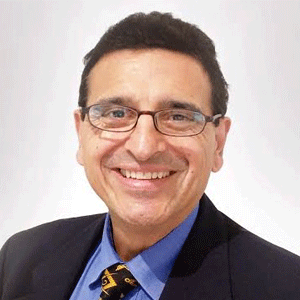
Harry Meier, Deputy Cio for Innovation, Department of Innovation and Technology, City of Mesa
 Harry Meier, Deputy Cio for Innovation, Department of Innovation and Technology, City of Mesa
Prior to 2020, the Smart Community was a hit among the buzzwords of our industry. Endless promises poured in of technologies bringing insight to government, deepening the connection between residents and their civic leaders, and realizing new services and efficiencies for our departments.
Then 2020 happened.
For many Cities and Towns, the impending doom of recession loomed over us, and the fluff of promises without immediate returns for the pandemic quickly fell away. Companies who once filled our spam folders with Smart City tech quickly turned to fighting the pandemic with surveillance, temperature cameras, contact tracing, and logistics for aid and vaccine distribution.
So where does that leave the Smart Community?
To put it simply, our residents still face the same challenges they did in 2019, and in many ways the pandemic and turmoil of 2020 only exposed how deep those challenges go. The digital divide between advantaged and disadvantaged communities went on display as schools shifted to remote learning. The need to connect out of work people with aid for food, rent, and utilities laid bare any shortcomings in our communications with the citizenry and our ability to get them that aid. The need to work together across departments, municipalities, and our local NGOs became unavoidable as the problems we faced were too big for anyone to go alone. And long-standing distrust of government showed some very real consequences.
Now that we see the light at the end of the pandemic
Where we invested in technology to help control the pandemic, use those investments to enhance services. For example, people counters and building automation create actionable data we can use to make more efficient use of resources. If you built HVAC controls to circulate air in offices and public waiting rooms, use that to react to the monitors you no longer need for social distancing. Use them instead to save energy in your buildings. Use those same people counters indoors and outdoors to show your local businesses that people are returning to our downtowns and that it’s time to invest in our communities.
Another example, if you built new ways for people to apply for CARES Act, ERAP, or any other aid, pivot those systems to make your old processes more efficient. If you built ways for people to communicate needs to their local governments and non-profits, stay connected because those needs won’t just go away.
If your Arts and Culture departments pivoted to streaming media to keep education and arts alive in our community, leverage those new skills to make those programs accessible even when the museums and arts centers and venues open again.
As schools go back to in person learning, don’t act like the digital divide goes away, work with your underserved communities to get them access to the digital services we all need to survive.
-
Smart Communities Were Never About The Tech. They’ve Always Been About The People, The Connections, And The Ways We Can Use Technology To Strengthen Them
As people go back to work, don’t lose the connections we made in the community, find ways to strengthen them and create a pipeline for innovation directly from those in need to the agencies who can help. Foster trust through connection with the people whose lives we touch every day.
And lastly, don’t forget the helpers living right around us. Hold onto those relationships as they may be key to your next project. Smart Communities were never about the tech. They’ve always been about the people, the connections, and the ways we can use technology to strengthen them. The Smart Communities of 2021 and beyond will be the ones who learn the lessons of 2020 and make good use of them. When the masks come off, let’s see the face of what’s to come.

