








APAC CIOOutlook
About UsConferencePartner With Us
  • Technologies
    • Blockchain
      Data Intelligence and Management
      Digital Transformation
      FinTech
      Generative and Agentic AI
      Low Code No Code
      Mobile Application
      Networking
      Robotics
      Storage
      Wireless
  • Industries
    • Automotive
      Aviation
      Banking
      Construction
      E-Commerce
      Food and Beverages
      Healthcare
      Insurance
      Logistics
      Manufacturing
      Retail
      Supply Chain
      Travel and Hospitality
  • Platforms
    • Microsoft
      Salesforce
      SAP
  • Strategic Solutions
    • Business Intelligence
      Contact Center
      Corporate Finance
      CRM
      Cyber Security
      Data Center
      Enterprise Asset Management
      Enterprise Performance Management
      IT Infrastructure and Services
      Managed Services
      Procurement
      Unified Communication
      Workflow
  • Home
  • CXO Insights
  • Leadership Perspectives
  • Innovation Insights
  • Research
  • News
  • Whitepapers
  • CXO Awards
#

Apac CIOOutlook Weekly Brief

×

Be first to read the latest tech news, Industry Leader's Insights, and CIO interviews of medium and large enterprises exclusively from Apac CIOOutlook

Subscribe

loading

THANK YOU FOR SUBSCRIBING

  • Home
  • Enterprise Performance Management
Editor's Pick (1 - 4 of 8)
left
Leveraging Data as an Enterprise Asset

Renee Wynn, CIO, NASA

Empowering the Digital Transformation of Asia's Growth Engines

Matt Oostveen, Chief Technology Officer, Asia Pacific & Japan, EMC Converged Platforms

Power to the People! Altering Enterprise Analytics Competency for the Future

Celine Siow, Regional Vice President, APAC & Japan, Alteryx

Is AI Transforming your Business? Rethink what's Possible

Andreas Hartl, General Manager, IBM Cloud & Cognitive Software, Asia Pacific

The Future of IT must be All Encompassing

Chris Kelly, Executive Director & GM - Infrastructure Solutions Group, Dell EMC

Timing is Everything

David W. Glenn, Partner & CIO, CIO Consulting Services, Tatum US

Digital Innovation on Rise Setting New Benchmarks

Greg Morrison, SVP & CIO, Cox Enterprises

Enterprise Cloud: Changing Business Requirements

Milind Karnik, SVP, Global Engineering, QLogic Corporation

right

Structure, Discipline, and Alignment Along with Technology Make Up the Secret Sauce of Organizational Success

Prashant Hoskote, Senior Director, Quality & Service Excellence Vice Chair – ASQ, Quality Management Division (Global) – Asia & Australia Board Member – National Board for Quality Promotion – Quality Council of India

Tweet
content-image

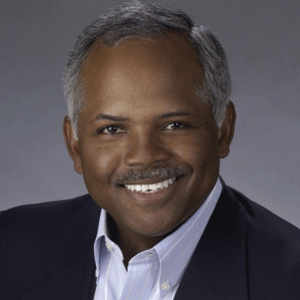
Prashant Hoskote, Senior Director, Quality & Service Excellence Vice Chair – ASQ, Quality Management Division (Global) – Asia & Australia Board Member – National Board for Quality Promotion – Quality Council of India

Any organization, whether it is technology, service, or manufacturing, can benefit from an integrated management system.

Almost a century ago, we began a modern approach to quality with rows of quality inspectors spot-checking random samples of manufacturing production and throwing unacceptable material in the scrap heap. Many organizations today (especially small and medium enterprises), struggle with how to reduce errors, minimize waste, speed up costly delays, and improve customer satisfaction. In the quality profession, we take pride in solving these issues. We have the skills and methods that highlight the problem elements of processes and lead us to changes and improvements that create efficient and cost saving approaches.

This is important, but in terms of what quality is today, and how it can help an organization succeed, this focus is on the wrong end of the real organizational challenges and opportunities. As W. Edwards Deming, the great quality guru of the twentieth century said, “Putting out fires is not improvement.”

The solution to operational problems lies in establishing or adopting a structure for an integrated management system, executing it carefully, and ensuring its aligned to the overall vision of the organization using technology as a conduit to enable this. If we let the tail wag the dog, i.e. bring in technology and then ask ourselves what do I do with it, we will always have interruptive and extremely costly operational issues.

So how can Organizational Quality and Excellence Frameworks help in this? If we don’t understand what Quality really does, we can’t make our organization successful and sustainable. And this is perhaps why CEOs still see quality as only an overhead cost, a tactical initiative, not a strategic one that can drive Business Results.

There are three types of quality—well, two little ‘q’ quality’s and one big ‘Q’ Quality. First, there is ‘Attribute quality’—what customers see. That is, if the customer sees attribute quality they will be happy with what you give them and ask for more. The customer will define this quality for you. This is an outcome, not where you start. But it can and must be measured.

Secondly, ‘Method quality’ is how we get to attribute quality—how we do the things we do. Here we not only have processes, but methods to manage, measure, and improve those processes. Method quality is driven by strategy. It’s primarily about efficiency and is dependent on what your customers want and what you need to accomplish.

Do not for a moment think that I am dismissing the importance of Attribute and Method quality. They are important to the success of any organization. Within them are the voice of the customer, the cost of operations, and the deployment of the strategy.

Many leaders see organizations as unavoidably complicated structures. They think of quality as simply a cost of measurement, checking, and rechecking. Smaller organizations, confused by quality jargon, avoid costs by not using any quality methods and measures until there’s a real problem. They are often led by the gut instincts of an entrepreneur, which may not address the inherent complexities of their organization, their target markets, or their customers. With all due respect and high regard, rather than learning Japanese quality jargon, using the Taguchi Method, Kanbans, or worrying about Lean, Six Sigma, and Poka Yoke, organizations should begin by focusing on key operational structures.

For lack of a better term, ‘Organizational Quality’ is how we have to think about, build, and operate our organizations.

If we don’t understand what quality really does, we can’t make our organization successful and sustainable

This is the only way we can develop a holistic strategic plan incorporating feedback from all our stakeholders (including vendors, partners, lost customers and employees), understand current customers, and markets, engage employees, measure our effectiveness, drive excellence, and prepare for the future.

What’s most important to understand is, Organizational Quality is a systemic view of an organization. The problem with attribute and method quality is they cause us to see operations and it’s associated issues as separate from the whole.

To be sure, organizational quality has to be measured, but what it requires is results-focused measures of effectiveness, not operational measures of efficiency. Effectiveness measures tell us if we are on the right trajectory and if what we are doing is sustainable. These measures tell us what to do better and where to focus our attribute and operational quality skills.

There are several approaches to implementing organizational quality and some of the key elements are as follows:

Lead with Passion - Leadership

More has been written about leadership than any other quality topic. Deming used to say, “A leader is a coach, not a judge.” In a nutshell, that’s exactly what a leader does—coaches the organization. He or she has a vision of the future and lays out the roadmap of how to get there. Organizational leaders set vision and values, and ensure that they are deployed. Leaders promote and foster ethical conduct, high performance, workforce learning, and customer focus. They set expectations and ensure good governance.

Plan and Execute - Strategy

Strategic planning is the simplest of ideas that we tend to make incredibly complicated. It’s little more than a roadmap to get from where you are to where you want to be.

Regardless of size, all organizations have objectives, complexity, and challenges. Strategic planning makes work easier by dividing it into smaller parts.

Understand Customers

The great management writer Peter F. Drucker observed that financial people believe that businesses make money, but in reality what they do is make a product or service that a customer needs—money may follow. Businesses cannot survive if they don’t understand the needs of their customers and markets. This requires developing ways to gather customer data and use information to change and improve value creation and delivery processes.

Measurement, Analysis, and Knowledge Management

Internal organizational measurements are critical to performance improvement. How your organization selects and uses data and information for performance measurement, analysis, and review in support of organizational planning and performance improvement. This guides your organization’s process management toward the achievement of key organizational results and strategic objectives, to anticipate and respond to rapid or unexpected organizational or external changes, and to identify best practices that may be shared.

This element also examines how your organization ensures the quality and availability of needed data, information, software, and hardware for all stakeholders and in the event of an emergency. It also examines how your organization builds and manages its knowledge assets.

Focus On the Workforce

Regardless of what else is done, nothing can be accomplished without the enthusiastic engagement of employees and other organizational support personnel.

Understand and Improve Processes

Most people involved in doing specific jobs believe that they understand their processes, but they generally don’t.

Evaluate Results for Effectiveness

The goal of most popular organizational improvement to do the right things that impact the organization’s higher goals. Effectiveness is driven by integrating everything the organization does and making sure it’s all working together as an operational system. Effectiveness, then, is a measurement of all the organization’s high-level goals. It answers the simple question, “Are we improving?” Improvement drives organizational success and sustainability.

These are just a few key elements of Organizational Quality.

So What Does This Have To Do With the CIO

Organizational Quality, at the level described, should be of primary interest to the CEO and all his Direct Reports… in particular the COO, CIO, CQO and Chief Marketing Officer. By reviewing the metrics and the results thereby produced by this high level approach, the leadership team can be assured the organization is moving in the right direction and they can challenge the organization's success in each important area. Too often the leadership team focuses only on financial success, but financial success can be achieved at the expense of long-term sustainability.
tag

Financial

Weekly Brief

loading
Top 10 Enterprise Performance Management Solution Companies - 2018
Featured Issue

I agree We use cookies on this website to enhance your user experience. By clicking any link on this page you are giving your consent for us to set cookies. More info

APAC CIOOutlook
Follow on LinkedIn

About

  • Home
  • About Us
  • Partner With Us

Stay Connected

  • Subscribe
  • Newsletter
  • Sitemap

Contact Us

  • editor@apacciooutlook.com
  • sales@apacciooutlook.com
  • marketing@apacciooutlook.com

Legal

  • Editorial Policy
  • Privacy Policy
  • Terms of Use

© 2026 APAC CIOOutlook. All rights reserved. Headquarteblue in Fort Lauderdale, FL, USA.

This content is copyright protected

However, if you would like to share the information in this article, you may use the link below:

https://www.apacciooutlook.com/views/structure-discipline-and-alignment-along-with-technology-make-up-the-secret-sauce-of-organizational-success-nwid-5750.html