












Successful Agile Adoption: Changing Culture, Not Process
Renee Geary, Head of Transformation and PMO, Catholic Church Insurance

Renee Geary, Head of Transformation and PMO, Catholic Church Insurance
However a considered approach towards the cultural, and in particular leadership change, is essential. Senior and middle management need time to acclimatize to the servant leadership model (shown in figure 1) that is integral to Agile. As Cappelli and Tavis (2018) outline, this model focuses on ‘coaching and supporting’ as opposed to ‘monitoring and directing’. Successful Agile adoption requires an investment in teaching or refining these coaching and supporting skills, which form the foundation of the long term leadership skills required to successfully embed Agile within a company’s culture.
In practice, the transition to Agile is a difficult one at best, and the cultural mindset and change management implications are paramount (Handscomb et al. 2019). Not only do the Agile ceremonies need to be adhered to along with other bottom up practices consistent with the Agile framework, but the change in the way senior management need to operate has a disproportionate influence on the culture of the organisation (Handscomb et al. 2019).To drive and realise the long term benefits of Agile, leaders must be willing to relinquish pre-existing ways of working.
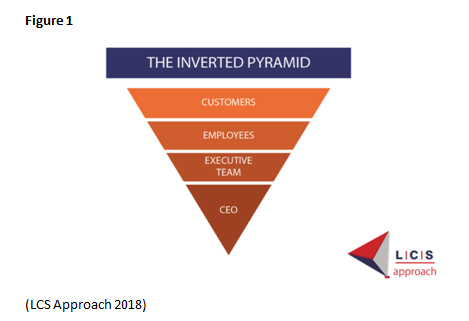 I was asked recently “when adopting Agile, what is the most difficult to change - people, process or technology?” Agile espouses the Servant Leadership model where the traditional is inverted and the leader serves his or her people. In my opinion, this is the most significant paradigm shift and one which management grapple with most. So to answer the question, it is possible to work with sub-optimal process and technology but without the right people components (leadership, advocacy, coaching and appropriate support) in place, the transition to Agile will undoubtedly suffer.
Agile adoption is on the rise and the benefits of an adaptable, stable and efficient model with high velocity can deliver significant value. However, organisations with tradition rich cultures, in particular, need to acknowledge that when embarking on major cultural shift, careful consideration is required from a senior leadership perspective. With 63% of existing company cultures at odds with agile values (Cappelli and Tavis, 2018), a heavy investment in culture and leadership is critical to maximize a successful long term adoption to Agile.
I was asked recently “when adopting Agile, what is the most difficult to change - people, process or technology?” Agile espouses the Servant Leadership model where the traditional is inverted and the leader serves his or her people. In my opinion, this is the most significant paradigm shift and one which management grapple with most. So to answer the question, it is possible to work with sub-optimal process and technology but without the right people components (leadership, advocacy, coaching and appropriate support) in place, the transition to Agile will undoubtedly suffer.
Agile adoption is on the rise and the benefits of an adaptable, stable and efficient model with high velocity can deliver significant value. However, organisations with tradition rich cultures, in particular, need to acknowledge that when embarking on major cultural shift, careful consideration is required from a senior leadership perspective. With 63% of existing company cultures at odds with agile values (Cappelli and Tavis, 2018), a heavy investment in culture and leadership is critical to maximize a successful long term adoption to Agile.
I was asked recently “when adopting Agile, what is the most difficult to change - people, process or technology?” Agile espouses the Servant Leadership model where the traditional is inverted and the leader serves his or her people. In my opinion, this is the most significant paradigm shift and one which management grapple with most. So to answer the question, it is possible to work with sub-optimal process and technology but without the right people components (leadership, advocacy, coaching and appropriate support) in place, the transition to Agile will undoubtedly suffer.
Agile adoption is on the rise and the benefits of an adaptable, stable and efficient model with high velocity can deliver significant value. However, organisations with tradition rich cultures, in particular, need to acknowledge that when embarking on major cultural shift, careful consideration is required from a senior leadership perspective. With 63% of existing company cultures at odds with agile values (Cappelli and Tavis, 2018), a heavy investment in culture and leadership is critical to maximize a successful long term adoption to Agile. 