

A featured contribution from Leadership Perspectives: a curated forum reserved for leaders nominated by our subscribers and vetted by the Construction Tech Review Advisory Board.

Benoy Hong Kong
The Architecture of Connectivity Building Communities in the Age of Smart Cities
Gregory Kovacs
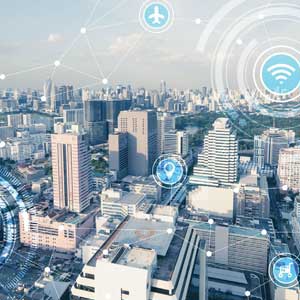
In recent years, science and systems engineering have employed computation to predict the behaviour of other complex systems with increasing reliability – the spread of disease, the weather, climate change. And today, the same tools enable us to gain an unprecedented understanding of our cities and devise interventions to improve their fabric, form and function.
They say data is the new oil; and nowhere is this more evident than in the development of smart cities, where data is harvested and deployed to manage assets and resources more efficiently. Responsive street lighting, optimised transport networks, enhanced waste management and reduced bureaucracy are just some of the many benefits of data-driven urban technology.
Around the world, private sector investment and government initiatives are driving smart city innovations. In London, UK, SmartPark solutions help drivers find parking spaces in the capital. In Toronto, Canada, The Sidewalk Labs masterplan provides a blueprint for improving city life through weather-adapting technology and urban mobility schemes. And in Hangzhou in Eastern China, tech giant Alibaba’s AI platform, City Brain, is rapidly reducing road congestion, with the megacity dropping from fifth to 57th on China’s list of most congested cities. It is an area of innovation that is growing in value globally – with the smart cities market size projected to reach an estimated $717.2 billion by 2023.
According to some, this rapid digitalisation of city infrastructure is an existential prerequisite. “In the long run,” says Dr Stefan Hartung from Bosch, “cities without intelligence will not survive”. This may, on a certain level, be true. But what is the social cost of this creeping permeation of data and tech into every aspect of urban life? Can smart cities help to strengthen community engagement and social bonds in the 21st century? And how can we avoid the dystopian visions of isolated individuals governed by ever more efficient algorithms?
Only the lonely
While we might not yet know the long-term effect of smart cities on the lives of their inhabitants, what we do know is that digital technology, for all its virtual connections and communities, can have an isolating influence.
In Japan, a highly technologically advanced country, over half a million people, known as hikikomori, live in social isolation. According to a government survey, roughly 541,000 people (1.57 percent of the population – although experts believe the total to be much higher), live as modern-day hermits, withdrawn from all social contact and, in some cases, not leaving their houses for years.
In recent years, science and systems engineering have employed computation to predict the behaviour of other complex systems with increasing reliability – the spread of disease, the weather, climate change
One of the central themes in the discussion of this trend is the socially isolating effect of digital technology. It is also thought that, due to Japan’s ageing population, by 2040, around 40 percent of the country’s inhabitants will live alone.
Increased social withdrawal and loneliness have also been observed in South Korea, Hong Kong, the USA and several European countries. And as we know, by 2050 two thirds of the world’s population will live in cities; so, are the cities of the future going to solve or exacerbate this growing social phenomenon? How can future cities (even at a mega-scale) reengage with their citizens and recreate the social bonds and sense of belonging found in smaller communities?
One of the world’s pioneering smart city projects isMasdar City in the UAE. A high-tech, multibillion-dollar development, Masdar City was originally intended to be the world’s first emission-free urban centre. It is a city at the cutting edge of innovation, with significant investment in smart technology and sustainable mixed-use infrastructure. Yet today, over ten years since developers first broke ground, its streets are largely deserted, and its residential targets and net-zero emissions goals remain unfulfilled. Indeed, Masdar City, along with Songdo in South Korea, provides evidence that while technology can improve the workings of a city, on its own it is never enough to cultivate a sustainable urban environment. In order to build a cohesive community and sense of place, the underlying culture must be the primary focus.
Transparency, trust and social connection
The city, we ought not to forget, is above all a cultural construct. Amid the relentless drive towards data, tech, innovation and efficiency, we must ensure that smart urban planning does not lose sight of people and communities.
We should also remember that the fabric of cities (both physical and digital) is an imprint of society. Changes within this fabric will facilitate new social interactions, ultimately changing society itself. And this is where smart cities if developed in the right way, have the greatest potential to deliver lasting positive change. They provide an opportunity to rethink the distinction between private and public space (not just at building level, but across entire neighbourhoods and districts).Our challenge is to create physical spaces that compete with and complement the digital landscape, facilitating real social interaction and community engagement.
And with smart cities comes smart governance. To what degree do we let machines make decisions about the social needs of the urban populace? If computer algorithms take over the role of politicians, who will set the nuanced optimisation process for these algorithms?
As a starting point, transparency must underpin the collection and use of data within smart city infrastructure and the use of open-source algorithms needs to be enforced. Through these efforts can we only establish genuine control over smart cities and achieve a bottom-up, participatory civil society, pointing the way to the next evolutionary step in urbanism: the emergence of responsive cities.
While architecture alone cannot solve these challenges, it can propose new visions for employing digital tools, in tandem with conventional physical structures, to create more humane environments. Environments that will best serve our evolving cities and societies, steering us away from the dystopia of isolation, towards a utopia of inclusivity, community and genuine social connection.
The articles from these contributors are based on their personal expertise and viewpoints, and do not necessarily reflect the opinions of their employers or affiliated organizations.
