

A featured contribution from Leadership Perspectives: a curated forum reserved for leaders nominated by our subscribers and vetted by the Construction Tech Review Advisory Board.

Rocky Scopelliti - Futurologist & Author
The 'Cognitive Enterprise' in a 4th Industrial Revolution World

How will we increase our capacity to adapt to a world of accelerated change?
To answer this question, we need to explore the relationship between technological change in the context of the environment that we can anticipate it will be exposed to – the 4th Industrial Revolution.
While the world’s cities cover just 2 per cent of the earth’s surface, today they account for 55 per cent of its population. Urbanisation of cities is predicted by the United Nations to be home to 86 per cent of global populations by 2050. We are indeed ‘homo urbanis’.
These cities will become smarter as they, and our lives and businesses, become increasingly digitally connected. Many analysts predict that by 2020, some 200 billion objects will be connected – 26 smart objects for every living person. Just imagine what data will be produced and what new services and businesses these will give rise to by 2020?
Data has become the 21st century’s energy, increasingly originating from urbanisation
As Klaus Schwab, founder and executive chairman of the World Economic Forum describes “we are at the beginning of a revolution that is fundamentally changing the way we live, work and relate to one another”.
This revolution is characterised by emerging technology breakthroughs with potentially highly disruptive effects in the areas of artificial intelligence, robotics, the internet of things (IoT), autonomous vehicles, 3D printing, biotechnology, nanotechnology, materials science, energy storage, blockchain and quantum computing.
Schwab further proposes that “businesses, industries and corporations will face continuous Darwinian pressure and as such, the philosophy of “always in beta” always evolving will become more prevalent”. To survive and thrive, enterprises must become ‘juvenescent’- defined as the constant state of youthfulness. I propose that we apply the meaning of this word as a principle upon which we live our lives, and as a leadership principle for how to manage organisations which need to constantly adapt in a world of accelerated change.
Intelligence is becoming predictive and artificially developed
The efficiency and effectiveness of how organisations use data is now a major source of competitive advantage.
Data is the lifeblood source of our digital existence. But unlike natural resources, it seems we treat it like there is an infinite supply of this valuable unnatural resource and we can somehow afford inefficiency and ineffectiveness because of its abundance. In fact, it is this abundance that creates a fundamental problem: the ability to identify and exploit the data that matters in a seemingly inexhaustible flood. Data also has some fundamentally different properties – unlike physical assets – the value of data increases through sharing and reuse.
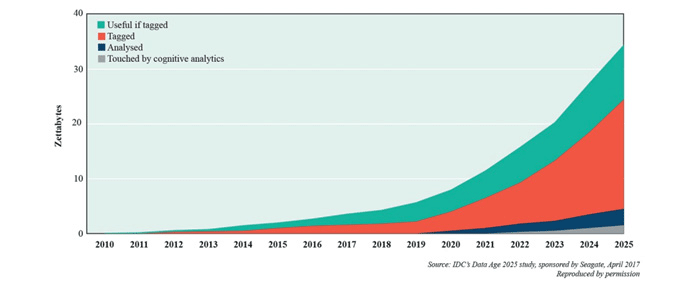
While data is the competitive currency of organisations in this digital age, few treat it as such.
Cognitive systems that change the landscape
Artificial intelligence and machine learning are two of the hottest topics at the moment. These emerging technologies collectively referred to as cognitive systems, convert data analysis into intelligence.
Cognitive automation replicates human actions and judgement at tremendous speed, scale, quality and lower cost. IDC predicts that by 2025, the amount of analysed data will grow by a factor of 50 to 5.2ZB and the amount of analysed data exposed to cognitive systems will grow by a factor of 100 to 1.4ZB (see Figure 1)
The artificial intelligence race is on by nations and enterprises
According to PWC , artificial intelligence could drive GDP gains of US$15.7 trillion with productivity and personalisation improvements. It claims global GDP could be 14 per cent higher in 2030 as a result of artificial intelligence of which productivity improvements could account for about half. PWC also reports that the greatest economic gains from artificial intelligence will be in China (26 per cent growth in GDP by 2030) and in North America (14.5 per cent growth) – the equivalent of US$10.7 trillion. It’s pretty obvious why these countries are in an artificial intelligence race.
At an industry level, its analysis reveals those that stand to benefit most (score of 5) and the least (score of 1) (see Table 1).
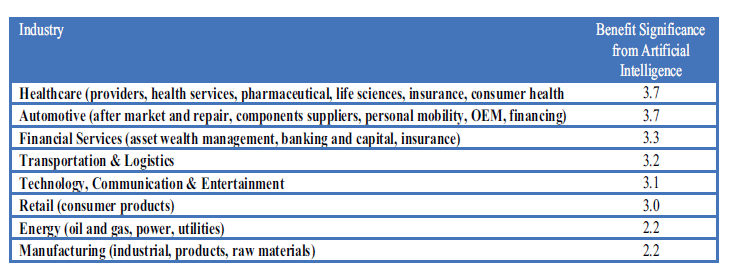
Table 1: Industry benefits from artificial intelligence
The eruption of artificial intelligence means that within the next five years we are likely to see artificial intelligence cognitive competitors emerge across many sectors. To traditional organisations struggling to transform their data and analytics environments, cognitive competitors will be able to attack their business models in ways and at scales, that non-transformed traditional organisations will struggle to detect, and respond to. The giant leap is shifting our thinking away from this resource (data) and its abundance, to it becoming the organisational intelligence – ‘The Cognitive Enterprise’.
Transforming to compete cognitively in the 4th Industrial Revolution requires a new leadership principle – one centred on constant adaption. Juvenescence, I propose will be the common characteristic found in successful next generation Cognitive Enterprises, and those that lead them.
