

A featured contribution from Leadership Perspectives: a curated forum reserved for leaders nominated by our subscribers and vetted by the Construction Tech Review Advisory Board.

Untuckit
The Phygital Frontier

Lockie Andrews
The retail industry has been slow to unite physical and digital (“phygital”) channels. COVID-19 accelerated digital and eCommerce adoption by at least ten years, causing supply chain, delivery, and operational issues at most retailers. In contrast, companies with agile and omnichannel infrastructure were well positioned. This article examines the key technologies driving retail success during the pandemic.
COVID Crisis
As I write this article, the United States is 140+ days into the first wave of the COVID-19 pandemic. The majority of brick and mortar stores have reopened with safety restrictions in place. Retail executives operate in a new paradigm as virus hot spots re-emerge in the southeast, forcing a possible second wave of store closures.management platforms, 4) workforce management tools and 5) CRM solutions with a 360-degree view of customers and products with online and offline integrations.
While the essential workers and medical teams were the undisputed heroes of the pandemic (7 pm applause please!), special recognition is also warranted for the operations and technology teams who kept companies running.management platforms
We are grateful for the sales associates who risked their lives to ensure consumers could buy everyday essentials, and the tech professionals who pivoted on a dime to set up remote work capabilities.management platforms, 4) workforce management tools and 5) CRM solutions with a 360-degree view of customers and products with online and offline integrations.
Underpinning life in this ‘new normal’ is the consistent and enabling presence of technology.
The stellar financial results reported by some brands were aided by frictionless shopping journeys that leveraged the best of phygital retailing.management platforms.
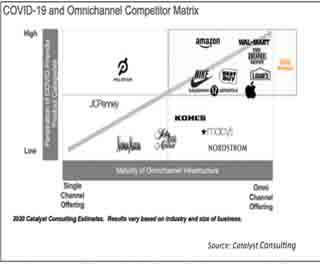
In Figure 1: COVID-19 and Omnichannel Competitor Matrix, we analyzed a competitive set of select large retailers. Evaluating each company’s penetration of COVID-friendly product categories versus their digital maturity helped explain the duality in financial results.
Based on their recent earnings reports, the COVID winners shared a similar playbook for responding to the crisis: 1) analyze data, predict trends, and in real-time shift their 2) inventory and supply chains 3) distribution strategies 4) human capital and 5) marketing dollars. The simplicity of the above statement completely masks the complexity involved in executing each of its tenets. Underlying the seemingly auto-magical experience of buying a product online and having it delivered to your doorstep is highly integrated and expensive technology infrastructure. Calling upon no less than five enterprise-level systems, omnichannel is the holy grail of phygital, and is the most elusive. The core enabling technologies required to execute the five phases successfully are as follows: 1) business analytics and real-time insights software, 2) enterprise resource management systems, 3) omnichannel order management platforms, 4) workforce management tools and 5) CRM solutions with a 360-degree view of customers and products with online and offline integrations.
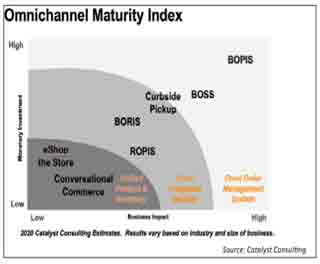
I have classified seven popular omnichannel use cases in Figure 2: Omnichannel Maturity Index to illustrate a brand’s linear journey to omnichannel from a customer’s perspective. While there is no “one way” to deploy these feature sets, Figure 3: Omnichannel Technology Infrastructure provides a practitioner’s perspective on the complexity, technology requirements, and potential business impact of each use case.
1.Unified Product and Inventory
Conversational Commerce (CC) is the first phygital solution. From a minimum viable product perspective, only a shared product catalog between the website and mobile point of sale (mPOS) is necessary.
Conversational commerce gives sales associates the ability to intercept website traffic and apply proven upsell techniques. The resulting increases in units per transaction and conversion should yield an attractive return on investment.
Another functionality that can be easily implemented with this technology stack is eShop Stores. Giving consumers the ability to shop from a store’s inventory allows a retailer to test interest in such a feature before investing in a fullscale launch.
2.Omnichannel Integrated Website
The ability to reserve a product or make an in-store styling appointment (ROPIS), return an online purchase in-store (BORIS), or purchase an online item for contactless store pickup (Curbside Pickup) represent the next phase in omnichannel maturity.
As noted in Figure 3, the key component of these online-to-store offerings has a flexible front-end website that synchronizes via a real-time API layer with inventory, financial, and mobile POS systems.
I was encouraged by the number of retailers who optimized their tech stacks during COVID and deployed these missioncritical technologies to keep customers safe.
3.Omnichannel Journey
The final leg of the omnichannel journey, buy online ship from/ to store (BOSS), and buy online pick up in-store (BOPIS, i.e., click and collect) is reserved for the winner’s circle.
Enabling BOSS and BOPIS requires not only having all of the technologies mentioned above but also integrating order management, in-store pick, pack and ship, and inventory planning systems. The significant investment combined with the pitfall laden path of tying together unwieldy backend systems can be daunting.
The pinnacle of omnichannel retailing is BOPIS, a combination of eShop Store, ROPIS, Curbside, and BOSS. To give you a sense of the magnitude of this initiative, several retailers have spent over $1 billion launching omnichannel.
Some savvy operators bolted on same-day delivery options via Postmates, Instacart, etc. This combined BOPIS plus home delivery experience rivaled Amazon’s, especially at the start of the pandemic, when many Prime delivery windows were extended.
The core technology for BOPIS is a front-end website with an intuitive user design that allows a shopper to search store inventory availability by zip code or location. Often requiring custom development, this offering is expensive, but postpandemic BOPIS is quickly becoming table stakes for digitallysavvy consumers.
As noted in Figure 4: The Benefits of Omnichannel, the incremental revenue lift, and enhanced loyalty from offering BOPIS are sizable. In addition to the financial benefits, organizations that successfully undergo digital transformation are poised for sustained future growth. All in, the pain experienced while pursuing omnichannel is worth it financially, and if not pursued, many retailers may experience the pain of bankruptcy.
I hope the retail industry will heed these painful lessons and will continue the digital transformation work, well in advance of the next market slow down.
