

A featured contribution from Leadership Perspectives: a curated forum reserved for leaders nominated by our subscribers and vetted by the Construction Tech Review Advisory Board.

Merck
Framework of Three Horizons to Manage Current and Future Growth
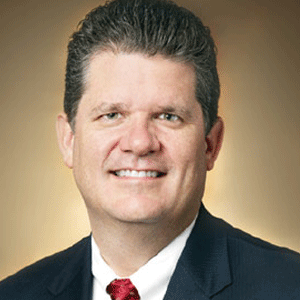
Clark Golestani
The healthcare industry has weathered many shifts over the last few decades, but the one we are facing today could very well be the most dramatic— especially if you are in Information Technology. In the past, IT was rarely on the front lines of the change. We provided support on the back-end—while teams including scientists, researchers and sales led the change effort. However, in a world where electronic medical records are a reality for many countries and patients are beginning to track their health via mobile phones or wearable technology—IT now finds itself in more of a co-pilot chair.
So what does that mean for the healthcare CIO?
As I think about the role of the CIO from when I first started my career and compare it to the CIO healthcare industry needs in the future, I see some obvious differences. CIOs have traditionally been technologists by trade. However, while this characteristic defined most CIO roles in the past, it is merely one out of three dimensions for the healthcare CIO in the future.
Before I get into those three dimensions, or roles, let me first explain the basis for them. McKinsey talks about a framework of Three Horizons that can help a company manage current performance while optimizing for future opportunity. I believe that lens can be adapted to an IT organization to manage both current and future growth. Horizon one for IT focuses on optimizing the core capabilities and operations for the company –basically driving productivity up while bringing costs down. Horizon two focuses on building out new capabilities that will help the business overachieve on its growth objectives. Lastly, the third Horizon represents disruptive technology and creating visionary, yet viable, options that could shake up the existing environment.
I personally use this framework as I think about my organization at Merck, and have found it leads to three roles that I must play to drive our organization forward and be successful.
Role One: Chief Technologist
This first role is an obvious one, and is most likely the role traditional CIOs gravitate to the most. A CIO must have a broad understanding of the
In this role, it is critical to continue to provide the organization with the digital tools and frameworks to take more and more cost out of the system while increasing productivity like never before.
Role Two: Business Steward
The second role is CIO as a business strategist. I feel that while this role is becoming more and more popular, it really should be table-stakes for anyone sitting in the C-Suite.
In this new environment, it is more critical than ever that the CIO and his staff understand the overall business strategy. This will enable them to not only align IT investments, but will allow greater focus on areas where they can drive competitive differentiation.
“In a world where electronic medical records are a reality for many countries and patients are beginning to track their health via mobile phones—IT now finds itself in more of a co-pilot chair”
Take information and analytics, for example. Big Data is indeed a big trend in our industry. There are lots of insights buried in the decades of clinical, patient and public data out there. IT needs to not only build the tools to help a company collect and make sense of all this information, but be experts in analysis as well. With rigorous data-driven processes, the CIO can enable the company to make more informed and strategic decisions.
Being a business steward, of course, also means translating many investments and results into business-friendly language. This can sometimes be an obstacle for IT leaders, especially those who fashion themselves a “Chief Technologist” first and foremost. But it is critical that CIOs master the art of business language and communication in order to elevate IT from a traditional “support role” to a true “strategic business partner.”
Role Three: Venture Capitalist
As the marketplace continues to shift at an increasingly fast pace, the CIO will need to help the business develop new capabilities, as well as new revenue streams. This could be an innovative application that the business can license out to customers or other organizations, a capability that gets spun off as a new company, or it could be a technology that actually disrupts the entire industry.
In a sense, this means the CIO needs to take on a more risk-taking role as the head of a start-up (or many start ups), fostering entrepreneurial skills in part of their organization to build businesses within a business. This is a drastic departure from the traditional style of slow, long-range IT processes and solutions.
It means investing in small groups within, and external to, their organization. It also could mean adding skill sets that aren’t typical for an IT department – such as accounting, new business modeling, marketing, legal, etc. Like a venture capitalist, the CIO will have to continually evaluate all of the assets and investments within their portfolio to ensure they are maximizing ROI for the organization. They will also need to continually communicate the quantitative results that these investments have made to the board, their peers, and to the organization at large.
The Opportunity Ahead
This is a dynamic and exciting time for a healthcare CIO. As with any change, it brings challenges. However, it also grants us the opportunity to be more integrated with the business than ever before— and, most importantly: it provides us the opportunity to drive change and transform both the industry and patients’ lives.
Check out: Top Healthcare Startups
