

A featured contribution from Leadership Perspectives: a curated forum reserved for leaders nominated by our subscribers and vetted by the Construction Tech Review Advisory Board.

San Francisco International Airport
IT Strategy: This Time, It's Personal
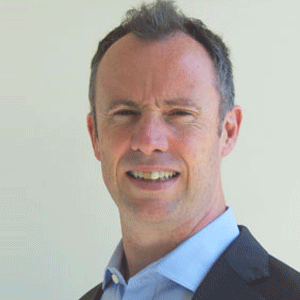
Ian Law
“More important than any of these ingredients is the personal mark of any CIO. This is a connection with the leadership culture of the organization that is being redefined. The CIO’s vision has the potential to create excitement and commitment from colleagues and partners. Through diagnosis, it should reveal the CIO’s personal insight into the organization’s challenges and opportunities and frame its strategic options. The strategy of any CIO must be nothing less than a personal statement of belief, of values, of character.”
“Jotting down a brief diagnosis of an organization, and revisiting it from time to time, can be an interesting exercise for any CIO to conduct”
While browsing many of the top-selling IT strategy books, one might be quickly overwhelmed by the quantity of prescriptive processes, rules and checklists found within. These books offer the unsuspecting reader a sterile path to a comprehensive set of strategic options and recommendations. While this approach may have been sound advice for CIOs even a few short years ago, today’s environment demands a radically more creative approach towards strategy. CIOs are required to be not only leaders of business and technology, but also visionaries. This challenge calls upon CIOs to focus less on process and more on putting their own character, values, and principles into the strategies they develop. This radical shift was eloquently summarized in a recent speech by Salim Ismail, Co-founder of the Singularity University. Ismail outlined how technological change, at its most potent, no longer simply transforms organizations or markets, but rather disrupts, and in some cases, annihilates them. Shared economies, autonomous vehicles, robotics and cheap computation are but a taste of the innovations that will sweep through organizations worldwide. And it is happening at unprecedented pace, scope and scale.
As traditional business models are upended, many organizations are looking towards their CIOs to play a prominent role in interpreting their strategic choices and developing a coherent plan to survive and thrive. A CIO’s success depends greatly on the extent to which the CIO understands and embraces this reality. This is not as easy as it sounds.
The organization and its vendors and partners will look towards the technology strategy as the CIO’s statement of strategic direction and intent. His technology strategy is more than a strategy; it’s
It’s easy to get caught up in the idea that tactical technological choices represent a strategic endgame. CIOs are constantly bombarded with technological choices; software defined networks and storage, analytics, clouds, Big Data, in-memory apps, gamification, robots and, of course, Internet of Things. The list goes on. It’s striking to witness the number of pundits, experts and commentators that refer to these as strategic choices. These are tactical options, not strategic choices, which might support the implementation of a given strategy.
The real strategic choices are more deeply embedded in the organization. They are those that truly change an organization’s mission or direction. They are considerably more emotional than tactical. They are as aligned to the leadership team’s values and culture as they are to business rationale or technological coherence. The CIO will lean on corporate values and convictions to guide the way through these strategic decisions.
A simple example of this can be found in a decision that all airports face: the choice of public Wi-Fi offerings to travelers. Airports typically have a number of choices in how they offer Wi-Fi services. SFO chose to provide the public with high quality Wi-Fi, free of charge and free of advertising. While the decision carried an up-front investment cost, it was consistent with our commitment to create an exceptional experience for our guests. For SFO, this investment has resulted in increased concession revenues, which help to recoup those initial costs. This is a purely subjective choice. From a strategy perspective there’s no right or wrong. The more the leadership team uses its shared values and principles as a reference framework for decision-making the more it creates uniquely distinct strategic choices. At SFO, this approach also paved the way for the integration of shared economy companies like Lyft and Uber. While the first instincts were to prohibit such activity, our guest-focused values paved the way for SFO to become the first airport in the U.S. to sign permits with multiple companies. Bypassing the minutia of the strategic process and getting to the central strategic themes is not easy. In his book Good Strategy, Bad Strategy, Richard Rummelt brought some much-needed simplicity to a subject which has been overcomplicated for a long time. Rummelt simplified the development of strategy to a 3-step process; (a) diagnose your situation, (b) create policies to deal with it and (c) develop coherent actions to support those policies. While this may sound deceptively simple, diagnosing an organization’s current situation can be a difficult, highly subjective, and time-consuming process. Jotting down a brief diagnosis of an organization, and revisiting it from time to time, can be an interesting exercise for any CIO to conduct.
More important than any of these ingredients is the personal mark of any CIO. This is a connection with the leadership culture of the organization that is being redefined. The CIO’s vision has the potential to create excitement and commitment from colleagues and partners. Through diagnosis, it should reveal the CIO’s personal insight into the organization’s challenges and opportunities and frame its strategic options. The strategy of any CIO must be nothing less than a personal statement of belief, of values, of character.
Days before his death the Irish Nobel Laureate writer Samuel Beckett penned his last poem, a contribution to the Great Book of Ireland. On finishing the last word he cast the ink pen aside and said “that’s done”. His final mark. Is your technology strategy leaving your distinct footprint on your organization?
