

A featured contribution from Leadership Perspectives: a curated forum reserved for leaders nominated by our subscribers and vetted by the Construction Tech Review Advisory Board.

The Farrer Park Company
Machine Learning & Artificial Intelligence in Healthcare Industry

James Woo
So do Artificial Intelligence (AI) and Machine Learning (ML) have a role in the healthcare industry? With more ethics, guidelines, checks and balances developed, I am confident that AI can contribute towards the betterment of human’s life from cradle to grave, covering key phases from
a. Preventive healthcare with the aim to keep healthy people healthy,
b. Disease/Sickness treatment with the focus on treating the sick and getting them well again
c. Recovery & Rehabilitation of patients to facilitate their recovery to as normal a condition as possible
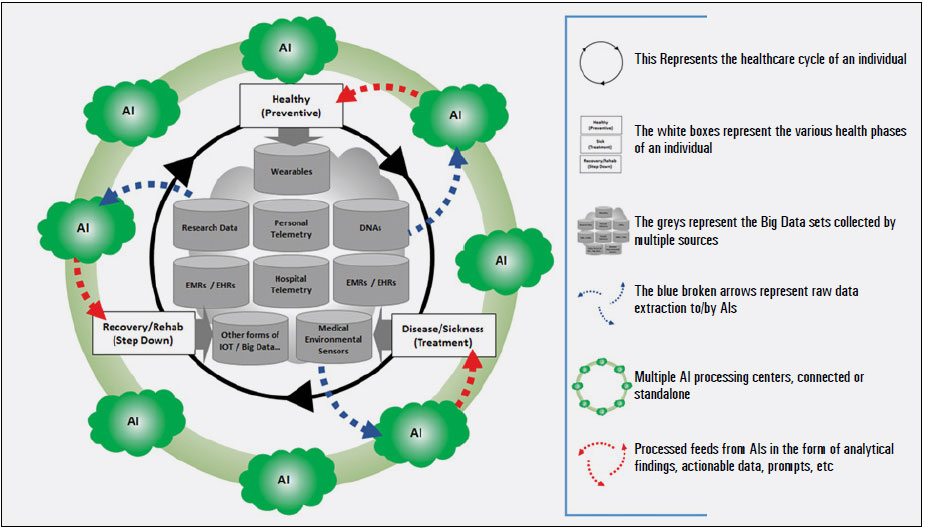
Whichever phase it might be, AI has a role to play in. Frost & Sullivan estimates the AI market in healthcare will reach $6.6 billion by 2021.The diagram shows the relationship between AIs and multiple Big Data sources to learn, analyze and feedback into the healthcare space.
Preventive
Given that it costs a lot more to treat a patient than to keep one healthy, it makes sense to utilize AI to keep healthy individuals out of the disease treatment cycle and in Singapore, this group is estimated at two third of the population. Some examples of AIs being explored for such preventive purpose,
a. Using AI with historical data from both preventive and treatment phases could be used to predict onset of chronic diseases, fatal diseases. Google with their DeepMind Health collaboration is working towards this direction. This project has the potential to identify potential health issues using datasets of de-personalised head and neck scans, and recommend the right course of action to a clinician.
b. Falls at home or not taking their medication on time, are constant problems with an aging population. Having an AI driven system or app to predict falls or identify poor adherence to medication regimen, can improve an elderly’s quality of life. ANGEL, the world’s first AI-powered, voice-driven healthcare assistant empowers aging-in-place seniors to live independently while their caregivers are constantly engaged and kept abreast of the senior’s health status through their award winning and patent-pending platform.
Disease treatment
Clinical data from EMR (diagnosis, treatments, test results, medication) together with telemetries from medical devices could be used by AI to improve medical diagnosis and recommend treatments to clinicians for their consideration. Two examples of such usage,
a. A MIT professor in collaboration with Massachusetts General Hospital is applying her natural language processing expertise in ML and AI to improve cancer diagnosis and treatment.
b. A US start-up, Path AI participated in an April 2016 challenge pitting their computer against an expert pathologist, in detecting breast cancer – computer had an error rate around 7.5 percent while the expert’s was about 3.5 percent. However, with more data for deep learning, the computer system surpassed the human expert 7 months later.
Recovery & Rehabilitation
Neofect founded in South Korea, created a product called Rapael Smart Glove, an exo-glove with built-in sensors and AI software to help stroke patients to regain their hand mobility. The gamification aspect of their rehabilitation solution allows the patient to use the Glove in conjunction with a Rapael app to play up to 45 rehabilitation games with varying degree of difficulty.
Disruption
Talking about disruption, there is one area which AI could be extremely disruptive particularly in primary care where one goes to their doctor for their common cough and cold sickness and/or chronic disease management follow ups. Can you imagine the day when someone with common cough and cold uses a mobile app to interact with a clinical bot driven by AI which can diagnose their condition, prescribe test and/or medication based on the symptoms entered into the app, facial recognition and/or past history? And, the patient can pick up their medication from the nearest pharmacy, or get it delivered to their house.
For a large country with limited access to clinical facility in the rural areas, such use of AI through a kiosk might not be such a bad idea. Same goes for chronic disease patient’s routine follow ups, and re-prescriptions. Perhaps we can start off by implementing a hybrid model by having online AI medical assistant bots carry out the diagnosis and with its recommendations being reviewed and endorsed by a human doctor before further steps could be taken – utilising the joint power of human and AI to address the shortage of clinical manpower and facility.
Moving Forward
There is definitely a role for AI to contribute in the healthcare space, and should we fear the human race being superseded by AI. Then we should confront these fears and work harder to discover and create the controls. And enable artificial intelligence to contribute safely to human’s wellbeing.
Check out: Top Artificial Intelligence Solution Companies in Europe
