

A featured contribution from Leadership Perspectives: a curated forum reserved for leaders nominated by our subscribers and vetted by the Construction Tech Review Advisory Board.

Kingsley Gate Partners
Three CEO Imperatives for Corporate Transformation
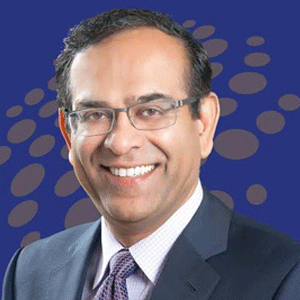
Umesh Ramakrishnan
Recent studies have shown that 4 out of 10 CEOs have doubt about the sustainability of their current business model, and yet 7 of 10 expect to be the same firm three years from now (KPMG). Though there may be a desire to build a company that can adapt and grow even in the face of outside forces like increased global competition, economic volatility, technology and regulatory changes, it is sometimes simply a case of “easier said than done.” The three CEO imperatives for corporate transformation are also simple in concept, but synchronizing vision, effectively articulating that vision and turning that vision into reality through flawless execution is a truly complex endeavor.
“The digitization of business has been underway for years from the seeds planted more than two decades ago with the advent of the World Wide Web.”
Create the Vision: Where Does the Company Need to Go To Remain Competitive?
“You’ve got to run a company for profit, you’ve got to run it for revenue growth, but you also have to run it to be around 10 years from now doing the right things. That’s one of the biggest issues most CEOs face today,” said Ajay Banga, President and CEO of MasterCard, US (19th annual CEO Survey, PWC). CEOs must foresee not just near-term challenges, but they must anticipate those that are yet to emerge and how they will meet those challenges on the road to the business it will become. Recently Intel’s CEO announced 12,000 layoffs in the company’s biggest restructuring in history. A painful step. He followed this by sharing his vision for Intel – to transform from a PC company to one that powers the cloud and billions of smart, connected computing devices. But how will Intel get there? What kind of talent will it need? And what roles will the remaining Intel employees play?
Articulate the Vision: How Do We Get ‘There’ and What Does ‘There’ Looks Like?
The digitization of business has been underway for years from the seeds planted more than two decades ago with the advent of the World Wide Web. This has driven a need for secure and robust digital storage and the recent boom in cloud technology. According to Bernstein Research, this year the cloud will have made up 60 percent of total IT spending growth, and by 2018 100 percent of dollar growth will be from cloud. While these figures may have informed Intel CEO Brian Krzanich’s corporate transformation vision, it would be worthless if he could not take that vision, flesh it out and clearly articulate how he would move it forward. And he did. Krzanich outlined on his company blog a five-point strategy for the company’s future, backed by why he believes these initiatives are critical to its growth. “The cloud is the most important trend shaping the future of the smart, connected world -- and thus Intel's future," Krzanich wrote. "The many things that make up the PC Client business and the Internet of Things are made much more valuable by their connection to the cloud." In laying out his vision, he also communicated Intel’s larger purpose, something nearly 60 percent of CEOs believe is important to communicate their value to a variety of stakeholders.
Execute the Vision: Defining the Structure, Talent and Benchmarks
What’s the path forward for Intel? When will the five-point strategy bear fruit and how will the company and its stakeholders measure success? Krzanich’s articulation of his strategy was a first step in what needs to be a hands-on pursuit for putting in place the organizational structure, talent and benchmarks for execution. In the coming weeks, months and years, he will need to not only reiterate what he has communicated but actually implement that strategy. Already Krzanich has said he may pursue acquisitions as a way forward. Should those acquisitions come to fruition, he will have to continually define his vision, articulate how it will unfold, set expectations and along with the downsizing of Intel’s employee base, start to execute. Of course this is a simplistic synopsis of what is no doubt a complex strategic transformation plan with many steps and stages in its execution. But at the heart of the corporate transformation Intel’s CEO has laid out are the essentials for success: the foresight to envision the company’s future, the ability to clearly communicate that to his fundamental stakeholders, and ostensibly, an ability to execute. Is Intel’s corporate transformation a fait accomplishment? Given our knowledge of Krzanich, I believe that we will see a new Intel in the not too distant future.
