











The City of the Future Is Connected, Resilient, and Sustainable
Chew Men Leong, President/Head, Urban Solutions, ST Engineering
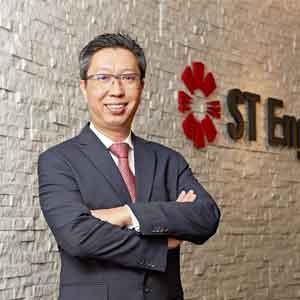
Chew Men Leong, President/Head, Urban Solutions, ST Engineering
Being Resilient
The proliferation of sensors, artificial intelligence, and data measurement platforms yield new benefits for security, bringing higher levels of situational awareness to cities. Remote surveillance and crowd sourcing, combined with sense making help detect anomalies and enable timely intervention. Even a humble but ubiquitous lamppost can be wired up to serve as a city sentinel, helping to monitor traffic, potential threats and environmental changes. In the current pandemic situation, smart city technologies offer increased and improved options for expeditious contact tracing and enforcement of safe distancing.
Being Sustainable
New combinations of connected technologies are driving greater efficiencies in utilities. Across various cities, utility systems are being retrofitted to move closer to net-zero outcomes. Intelligent power grids enable optimal injection of renewable energy. Smarter water grids reduce network leakage. On-demand lighting, air-conditioning and waste management allow the optimal matching of services and supply to human demand.
In land transportation, the need for car ownership is reducing gradually as more efficient and affordable, seamless end-to-end mass transit options are offered to commuters. Meanwhile, we have also witnessed a transformation with the rollout of shared and autonomous public transportation, facilitated by Mobility-as-a-Service applications, and a shift to electric transportation platforms, which significantly decrease traffic congestion, pollution and the carbon footprint of every passenger.
People are at the Core of Smart Cities
Ultimately, smart city technologies are not the end, but rather a means to the end, to improve quality of life for citizens. Developing smart city solutions that are citizen-centric and resolve issues related to daily living provide tangible value and is critical for successful adoption.
At ST Engineering, we have a single-minded aim to help cities overcome their key urban challenges to improve quality of life for their communities. We focus on the mobility, security and environment domains, providing a portfolio of innovations that extend across smart metro, intelligent traffic management, fleet telematics, IoT and data platforms, cloud-enabled smart buildings and estates, smart security systems, data connectivity, healthcare robotics, autonomous vehicles, and even sustainable urban cooling. We are also growing capabilities in new areas such as digital mobility payments, intelligent energy management and electric vehicles, among others.
ST Engineering has been in the smart city business for many years, and has built a track record of more than 700 smart city projects in over 130 cities across the globe. We are also an active participant in Singapore’s Smart City initiatives. We believe our smart city portfolio and extensive operational experience stand us in good stead to help cities advance along their journeys to become more connected, resilient and sustainable, creating a better future for generations to come.

